How to Measure Content Performance When AI Search Reduces Clicks

With zero-click steadily climbing, companies are trying new methods for tracking content performance. Check out these five alternative metrics.
Between November and December 2024, HubSpot’s estimated organic traffic fell from 13.5 million monthly visits to 8.6 million, a staggering loss of nearly 5 million visits in a single month.
For a company long considered the gold standard in content marketing, the decline quickly became one of the most dissected case studies in search, generating no shortage of analysis and speculation.
However, despite the collapse in clicks, HubSpot remained the dominant brand in AI-generated answers within its category. One analysis estimated its share of voice in AI responses at 35.3%, with the company cited in nearly every answer to leading prompts related to its core products.
HubSpot CEO Yamini Rangan even acknowledged the shift during an earnings call, noting that organic search traffic was declining globally and that the company was now focused on figuring out how to appear more prominently in AI-generated answers.
That is where our argument begins. The clicks fell, but HubSpot’s influence did not disappear with them.
Its content was still being found, cited and used to shape the answers people received. Buyers may not have visited the website in the same numbers, but they were still encountering the brand before making a decision.
A reporting framework built around clicks alone would miss all of this. Why? Because the traditional dashboard was never designed to show where a brand appears in AI answers, or how that visibility shapes what buyers know.
Measuring content now means looking beyond the visit. This piece explains what else to track and how to build a framework that reflects the value content creates, even when a click never happens.
The Metric That Broke First: Organic Traffic
Traffic was never a perfect proxy for content performance, but it was a convenient one.
When people discovered content by searching for something, scanning the results and clicking through to a page, session volume gave teams a reasonable sense of how many people their work was reaching.
That journey is becoming less common.
Research from SparkToro and Datos found that for every 1,000 Google searches in the US, only 360 clicks went to websites outside Google’s own properties. Meanwhile, 58.5% of searches ended without a click at all.
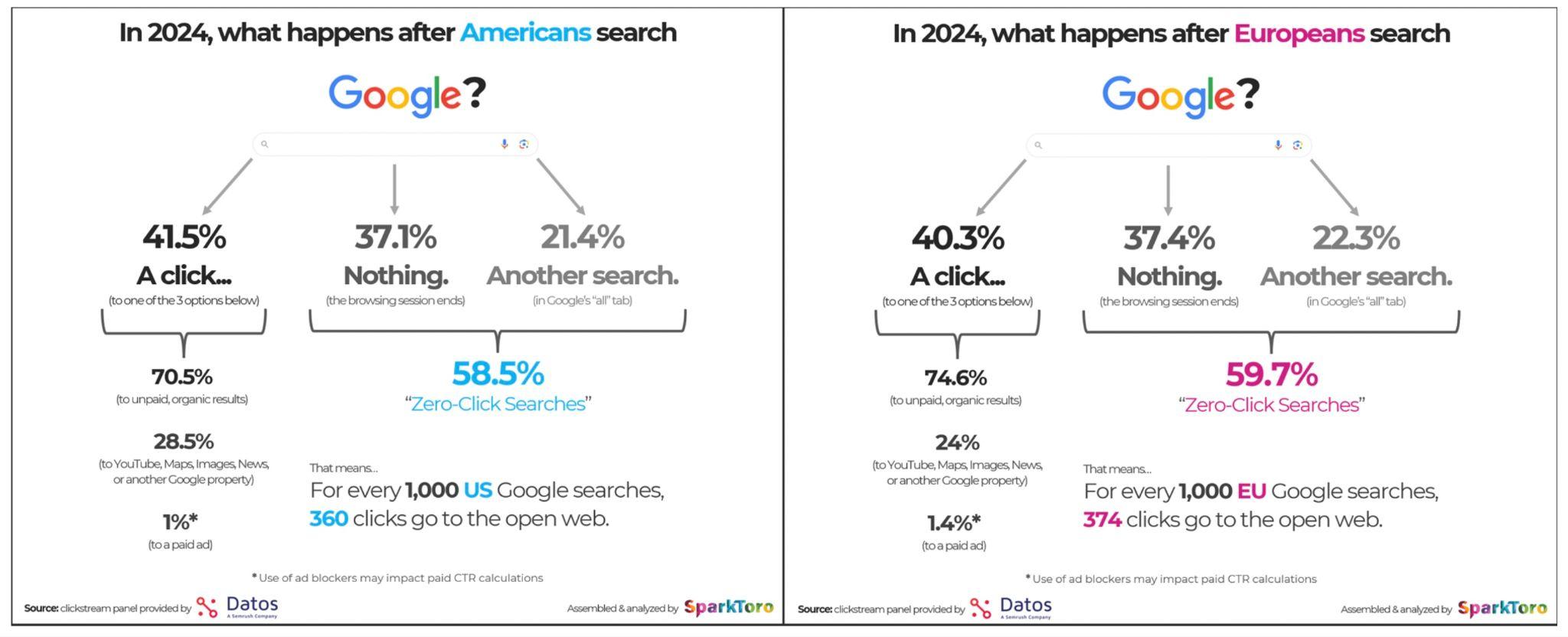
Image source: Sparktoro
Some of those searches likely ended because the answer was already visible on the results page, through an AI Overview, featured snippet, knowledge panel or similar feature. Others ended because the searcher abandoned the session or tried a different query.
Either way, the result for publishers is the same: a large share of search activity never becomes a website visit. This creates a growing gap between the value content provides in search and the traffic that appears in analytics.
Does this mean traffic is now useless? Of course not. It only signals that traffic can no longer tell the whole story on its own.
This shift calls for a new measurement model, which we’ll explore below.
What to Measure Instead
1. AI Citation and Mention Rates
GoodFirms found that while 43% of marketers are actively optimizing their content for AI search, only 14% are actually measuring it. That’s a huge gap.
Citation rate asks a direct question: how often does your content appear as a source in AI-generated answers across ChatGPT, Perplexity, Google AI Overviews and comparable platforms?
Mention rate measures how often your brand is named in those answers, even when your content is not cited as the source. Tracking both shows whether AI platforms are using your content as evidence, simply recognizing your brand or doing both.
This matters not just for visibility, but for downstream commercial outcomes. According to Seer Interactive, brands cited in AI Overviews earn 35% more organic clicks and 91% more paid clicks compared to brands not cited on the same queries.
You can track this metric either by manually spot-checking your highest-value queries across AI platforms or by using a dedicated GEO measurement tool to monitor your AI visibility over time.
2. Engagement Rate and Content Journey Depth
When a user actually does click through from an AI search tool, they aren’t looking for a quick definition. They’ve already read the AI’s summary. They are clicking through because they want the deep, raw, highly detailed proof.
This means AI-referred traffic tends to come from users with higher intent.
So instead of obsessing over raw session volume, look at:
- Engagement rate: Are they actually interacting with the page, or bouncing?
- Scroll depth: How far down the page are they going?
- Journey progression: Are they clicking your internal links to read more?
A blog post with 500 visits and a 70% engagement rate is infinitely more valuable than a top-of-funnel keyword piece that gets 10,000 visits but has a 95% bounce rate because an AI Overview already answered the user’s quick question.
3. Multi-Touch Conversion Attribution
B2B buying journeys are notoriously dark. A report from 6sense found that 94% of buyers use LLMs during their research process, and they choose a vendor from their “day-one shortlist” 95% of the time.
Some of the research shaping that shortlist now happens inside private ChatGPT threads, Perplexity queries and Copilot chats that traditional analytics cannot see.
If you use last-click attribution, content gets zero credit. A buyer might read three of your blog posts, see you cited in a Perplexity answer, search your brand name on Google and click a paid ad to request a demo. Last-click will hand 100% of the credit to Paid Search.
The fix is to track content-assisted conversions across the full journey. You need to see which pages are consistently touched by buyers before they convert, regardless of where that final, converting click came from.
This is where a platform like Progress Sitefinity Insight becomes useful. It captures behavioral journey data and attribution signals across sessions, allowing teams to see which content drives conversions.
4. Branded Search Volume
One of the most fascinating side effects of AI citation is how it drives branded search.
When ChatGPT recommends your software as a top solution, most users don’t click the tiny citation footnote. Instead, they open a new tab and search your brand name directly.
This branded traffic gets misattributed to “Direct” or “Organic Brand” in your dashboards, but its true origin was an AI mention. If your branded search volume is growing while your informational, top-of-funnel traffic is slipping, your AI visibility strategy is working perfectly.
5. Pipeline Influence
Another important measurement shift is to move from asking, “Which content sourced this lead?” to asking, “Which content influenced this deal?”
Adobe Digital Insights analyzed more than one trillion visits to US retail sites and found that AI-referred visitors converted 31% better than non-AI traffic during the 2025 holiday season. By March 2026, that advantage had grown to 42%, while revenue per visit was 37% higher.
Adobe partly attributes this performance to the research and comparison work that shoppers complete inside AI tools before visiting a website.
By the time they click through, they often have a clearer understanding of their options and are closer to making a decision. That makes traffic volume alone an incomplete measure of the value AI visibility creates.
For B2B content teams, the same principle applies across a much longer sales cycle. Connect your marketing data to your CRM and track pipeline influence: the percentage of closed-won deals in which buyers interacted with your content before making a purchase.
This gives content credit for helping buyers research, compare and validate their options, even when another channel captures the final conversion.
The Role of Your CMS in Making This Measurable
Most of this framework is technically available to any content team.
The challenge is operational: bringing data from organic search tools, AI citation trackers, website analytics and CRM systems together into a picture that can be reported on consistently.
This turns the CMS into part of the measurement infrastructure, rather than simply the place where content is published.
A platform that captures behavioral data, connects content consumption to conversion events, and attributes value across the journey can reduce much of the analytical overhead.
Progress Sitefinity Insight provides this behavioral and attribution layer. It tracks visitor interactions across sessions, builds audience segments around the content people consume, and calculates how individual pages and touchpoints contribute to conversions.
Its content recommender can also use patterns from successful conversion journeys to determine which page a visitor should see next. When Sitefinity Insight is connected to CRM and other business data, these journeys can be tied to later outcomes beyond the website.
For teams trying to demonstrate content ROI in an environment where traffic no longer tells the full story, that connected view makes the measurement framework above more executable than theoretical.
Enjoyed this article?
Add Progress as a preferred source to see more of our content in Google search.
Add Progress as a preferred source on Google
John Iwuozor
Content Lead

