
When Content Loses Context, It Loses Value
Media and publishing teams get AI-enabled discovery that preserves meaning, rights and editorial trust across every platform and audience.
Trusted by

Fragmented Content and Weak Metadata Are Worth Less Than You Think
Media and publishing organizations manage growing volumes of text, video, audio, images and archives while serving audiences across more channels and devices. The challenge isn’t scale, it’s fragmentation. When metadata is inconsistent and content relationships are weak, discovery suffers, reuse slows, rights get risky and monetization opportunities quietly disappear.
The Progress® Data Platform helps media and publishing teams connect content, apply richer meaning and support AI-driven discovery and personalization, without losing editorial control or rights governance.
Data stored in media management platforms grew to 324 petabytes in 2025, expanding 56% from the previous year.
Why Companies Trust the Progress
Data Platform
Proof That Content Teams Create More Value with Connected Context
 Customer Stories
Media & Entertainment, Publishing
Leading Canadian News Agency Leverages the Progress Semaphore Solution to Increase Content Discoverability, Enhancing the Customer Experience- Richer metadata driving improved discovery and new revenue opportunities

Validated by the Experts, Leading with Outcomes


Who This Is For

You need content to be easier to find, reuse and activate across brands and channels.

You need better discovery and recommendations without putting editorial trust at risk.
.png?sfvrsn=7b4b0a04_3)
You need stronger personalization, better content performance and more relevant monetization.
.png?sfvrsn=367b0718_3)
You need a platform that can connect content systems, archives and metadata at scale.
What Media and Publishing Teams Can Do with the Progress Data Platform
Help Audiences Find What Matters, Faster
Give users, editors and customers the right content across formats and archives, without waiting on manual tagging to catch up.
How It Works
Enriches content with shared meaning and relationships so search and discovery work better across the entire catalog.
ExploreA leading Canadian news agency reports richer metadata improved search experience and product value
Scale Metadata Without Scaling Manual Work
Reduce manual tagging effort while improving consistency across content operations, rights and classifications.
How It Works
Supports stronger metadata, classification and connected content relationships across archives and CMS platforms.
ExplorePublishers report meaningful gains in content reuse and monetization after semantic enrichment
Deliver Experiences Audiences Come Back For
Give audiences faster, more relevant and more engaging experiences across every device they show up on.
How It Works
Connects catalogs, behavior signals and content relationships into a usable structure for AI and search.
Explore50,000 requests per min/100M views in 3 mos
Handled by NBCUniversal
Turn the Archive Back into an Asset
Make older content easier to surface, package and monetize across syndication, licensing and product workflows.
How It Works
Supports richer relationships between content, topics, rights and audience needs in a unified, queryable layer.
Explore95%
of online revenue generated through Springer's content platform
How the Progress Data Platform Delivers for Media & Publishing
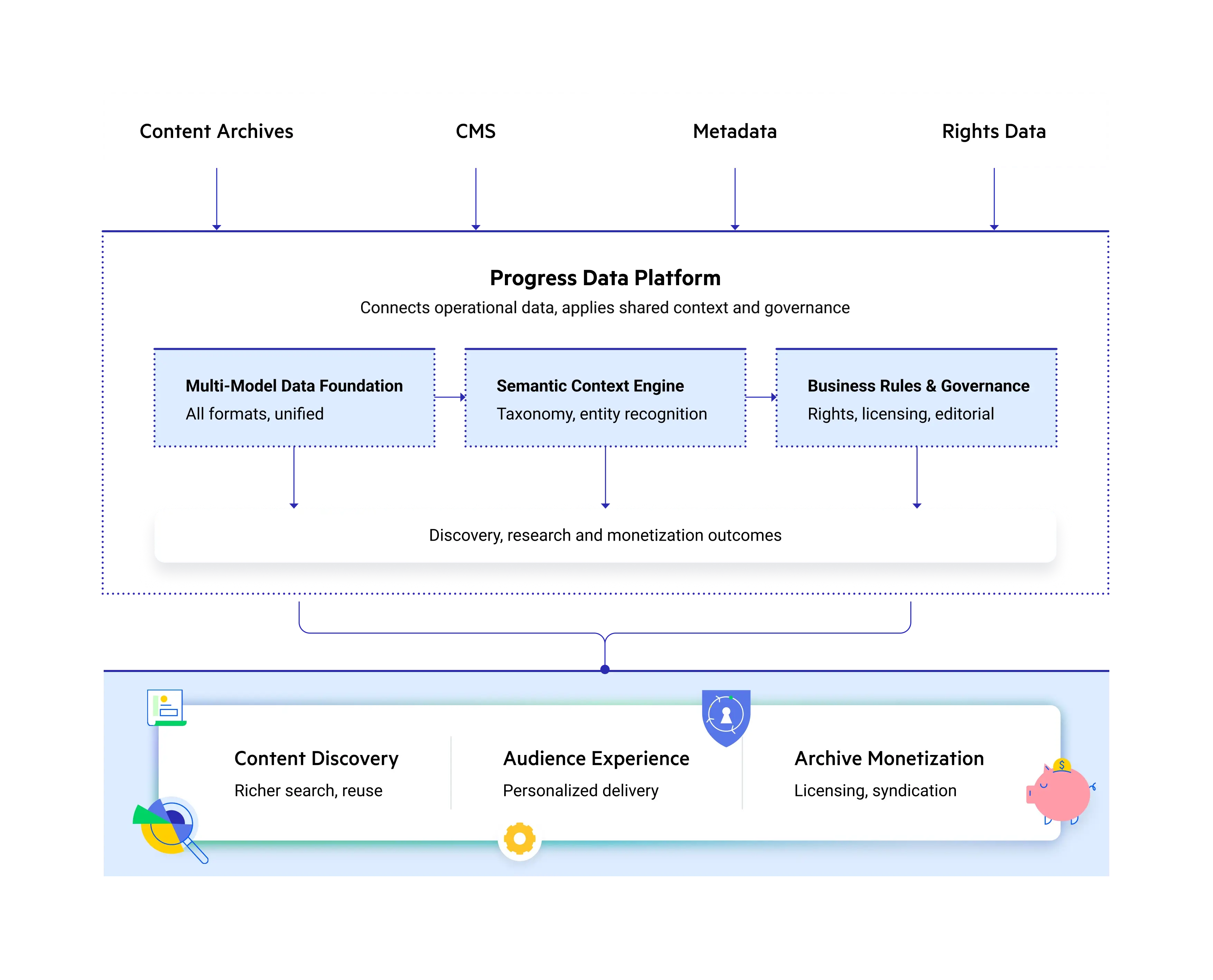
The Progress Data Platform helps media and publishing organizations connect scattered content, apply shared meaning and support AI-driven discovery with stronger governance. It works across structured and unstructured information, makes content easier to search and reuse, and gives AI the context layer it needs for recommendations, retrieval and workflow support.
Multi-Model Data Foundation
Unifies content, metadata and rights information across formats.
Semantic Context
Engine
Enriches content with consistent taxonomy and entity recognition.
Business Rules & Governance
Enforces rights, licensing and editorial governance.




FAQs

Protect and Extend the Value of
Your Content
Talk with a Progress specialist about the discovery, metadata or audience experience challenge you want to solve, and how to turn your content back into an asset.