
Agentic & Semantic AI You Can Put into Production
Give AI agents the meaning, memory and guardrails to reason, act and produce explainable outcomes.

One Trusted Foundation:
Connect, Create, Consume
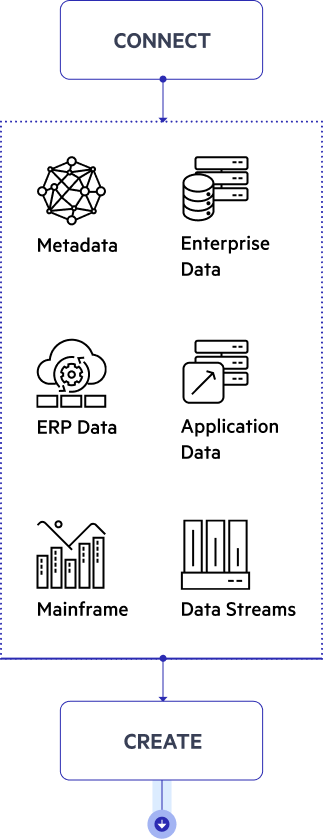
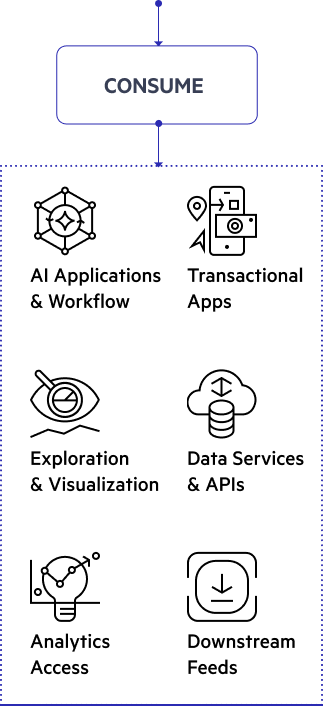
Agentic & semantic AI lives in the Create layer of the Progress® Data Platform—where connected data becomes governed, meaning-rich context that agents and applications can safely consume.


Most Enterprises Have Agents, Few Can Govern Them
96%
of organizations are already using
AI agents
Only 12%
have a platform to manage them
94%
say agent sprawl is increasing complexity, technical debt and risk
The issue isn’t whether agents can act. It’s whether they can act in ways you can trust, govern and explain. Autonomy without context is unpredictable; autonomy without policy is unmanaged risk. Production-grade agentic AI is an architecture problem, not a model problem: agents need grounded meaning to reason well and explicit rails to act safely.
Grounded Meaning Plus Governed Action
Agentic and semantic AI work together: semantic context tells an agent what enterprise information actually means, and governed workflows control what the agent is allowed to do with it.
Ground Every Step in Semantic Context
Agents reason over a connected model of enterprise meaning—entities, relationships and domain concepts—not loose keywords or vector similarity alone. Better context produces better reasoning and fewer wrong turns.
Retrieve with Evidence, Not Guesswork
Retrieval-augmented generation (RAG) pulls answers from governed enterprise sources with citations, so responses are traceable to verified data rather than probabilistic guesses.
Act Within Explicit Policy
Deterministic rules and policy checkpoints constrain what agents can do, adding human-in-the-loop review where decisions carry risk. Neural models supply flexibility; rules supply control.
Orchestration and End-to-End Explanation
Multi-step workflows are sequenced, logged and reviewable so you can trace any action back through the context it used and the policies that governed it.
From Impressive Demos to Dependable Outcomes
Agentic AI earns enterprise trust when its behavior is grounded, governed and explainable. Here’s what that means for each stakeholder:
Production Value, Not Pilot Theater
Moves agents from experiment to operation with outcomes you can defend to a board, a regulator or a customer. Reliability becomes the differentiator—the point of making AI boring, in the best way.
Safe, Scalable Architecture
Combines multimodal retrieval, semantic enrichment and a policy layer on one foundation—instead of stitching together vector stores, prompt hacks and bespoke guardrails that break under load.
Explainable, Reviewable Autonomy
Every agent action carries a traceable chain of evidence and policy. When something is questioned, you can show what happened, why it happened and which rules were applied.
See The Idea in Action: Why Accuracy Compounds Across Agent Steps
Every step an agent takes multiplies its error. Move the sliders to see how per-step accuracy and chain length change the odds of a correct end-to-end result.
- Short Chain · 3 Steps
- Typical · 5 Steps
- Long · 8 Steps
Agentic-only RAG — ~78% per step
47%Governed multimodal — ~92% per step
78%+31 pts
the governance gap at 3 steps – agentic-only already below 50%
Even a short chain leaks accuracy
At just 3 steps, agentic-only RAG has already dropped to 47%—worse than half. Governed grounding still delivers 78%, roughly what agentic-only manages per single-step.
Agentic-only RAG — ~78% per step
29%Governed multimodal — ~92% per step
66%+37 pts
the governance gap at 5 steps – agentic-only fails 2 of 3 runs
At typical chains, the workflow tips
At 5 steps, agentic-only falls to 29%—failure twice as likely as success—while governed grounding holds a usable 66%. Same workflow, same cost; only per-step accuracy differs.
Agentic-only RAG — ~78% per step
14%Governed multimodal — ~92% per step
51%+37 pts
the governance gap at 8 steps – evenly governed as a coin flip
Long chains are unviable without governance
At 8 steps, agentic-only collapses to 14%, and even governed grounding drops to a coin flip (51%)—pleading the case for keeping chains short and every step grounded.
Accelerate AI with Semantic Intelligence
Learn how Progress Data Platform provides the semantic foundation for enterprise-grade AI and intelligent automation.
The Evidence for Governed Agentic AI
Accuracy compounds, or degrades, with every step an agent takes. The architecture beneath your agents determines which. Grounding in graph and ontology—not vector similarity alone—is what moves outcomes from fragile to dependable, including:
What Teams Build With It
Governed Knowledge Assistants
Employee, customer and partner assistants that answer from trusted enterprise knowledge with citations and never surface what a user isn’t permitted to see.
Learn MoreDeep Research & Intelligence Workflows
Agents that iterate across long-running investigations, synthesize across data types and trace every conclusion back to its source.
Learn MorePolicy-Governed Decisioning
Agents that combine AI insight with deterministic rules to recommend or automate decisions responsibly in regulated processes.
Multi-Step Operational Automation
Workflows where agents act across enterprise systems through controlled, auditable access with humans in the loop where it matters.
FAQs
Build Agents You Can Actually Put Into Production
See how the Progress Data Platform grounds agentic and semantic AI in trusted context, governed workflows and explainable outcomes.