
One Governed Data Model for Trustworthy AI
Unifies structured and unstructured data under a single model with lineage, provenance and policy built in—so AI outputs are traceable, auditable and defensible, even in your most regulated environments.

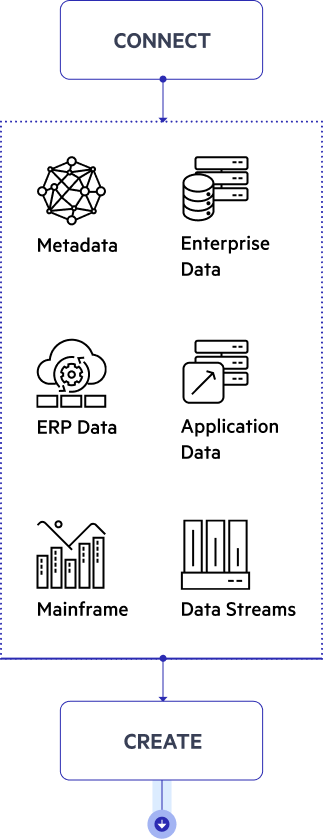
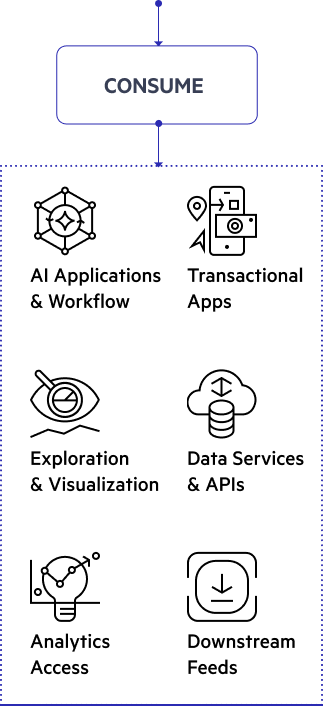
One Trusted Foundation: Connect, Create, Consume
The governed data model is the backbone of the Create layer of the Progress® Data Platform, the single, governed foundation on which the platform’s context, security and rules all operate. Explore the other capabilities in the Create layer below.


Fragmented Data Can’t Produce Defensible AI
Enterprise knowledge is rarely neat or flat. It’s scattered across documents, databases, JSON, XML, RDF and line-of-business systems—and when it’s fragmented and inconsistently governed, AI built on top inherits the mess.
Re-materializing everything into yet another store adds cost, latency and a new place for governance to break. To produce outputs you can defend, the data and its governance have to live together: one model that holds many data types and carries lineage, provenance and policy with the data itself.
Many Data Types, One Governed Model
A multimodel foundation holds documents, data, relationships and semantics together—with governance embedded, not appended.
Unifies Structured and Unstructured Data
Documents, JSON, relational, graph (property + RDF), vector, temporal and geospatial data live in one platform with no fragmentation and no constant re-materialization between stores.
Embeds Lineage and Provenance
The model tracks where information came from and how it was used, so any AI output can be traced back to its sources and the steps that produced it.
Carries Policy with the Data
Access and usage policy travel with the data model itself, so governance holds consistently wherever the data is used.
Produces Traceable, Defensible Outputs
Because context and control share one foundation, you can explain and defend AI results—not just report what data was touched, but why an answer was given.
Governance That Makes AI Defensible
A governed data model turns AI from interesting to acceptable—and from useful to defensible.
Defensible Outcomes You Can
Stand Behind
When an AI-driven result is questioned by a regulator, auditor or customer, you can show the evidence chain behind it. Trust compounds with every defensible answer.
Less Plumbing, More Consistency
One multimodel foundation reduces the copy-and-sync sprawl of separate stores for documents, search, graph and vectors—and keeps governance consistent across them.
Lineage and Provenance by Default
Built-in traceability supports audit and explainability requirements, including the documentation expectations rising under regulations such as the EU AI Act.
See the Idea in Action: One Governed Model, Many Data Types
Click a data type. In a multimodel foundation, all of these live under one governed model—with lineage and policy that travel with the data.
- Documents
- JSON
- Relational
- Graph
- Vector
- Temporal
- Geospatial
Document Intelligence
Contracts, PDFs and reports are managed as first-class data—not flattened into rows—with their structure and meaning preserved for retrieval.
Unified and Governed
Lineage and policy travel with the data—all seven types live under one governed model, not seven stores.
Native Data Integration
Application and API data lands natively, so operational records sit alongside documents and graph in the same governed model.
Unified and Governed
Lineage and policy travel with the data—all seven types live under one governed model, not seven stores.
Unified Relational Data
Structured tables are queried in place, unified with unstructured content instead of copied into a separate store.
Unified and Governed
Lineage and policy travel with the data—all seven types live under one governed model, not seven stores.
Knowledge Graph
Property and RDF relationships connect entities, enabling explainable, relationship-based reasoning across the model.
Unified and Governed
Lineage and policy travel with the data—all seven types live under one governed model, not seven stores.
Semantic Search
Embeddings power similarity search in the same platform, so semantic and vector retrieval are governed together.
Unified and Governed
Lineage and policy travel with the data—all seven types live under one governed model, not seven stores.
Historical Data
Bitemporal data preserves what was true and when, which is essential for audit, reconstruction and defensible history.
Unified and Governed
Lineage and policy travel with the data—all seven types live under one governed model, not seven stores.
Location Intelligence
Location data is modeled and queried natively, adding the where to the what across the governed model.
Unified and Governed
Lineage and policy travel with the data—all seven types live under one governed model, not seven stores.
Ensure Quality, Consistency and Compliance
Create a trusted, governed foundation that ensures consistency, quality and compliance across data assets.
Trace Meaning, Not Just Data
Most platforms can tell you what data was accessed. A governed data model with semantic provenance tells you why an answer was given—the difference between data lineage and defensible AI, such as:
7 Models,
1 Platform
Document, JSON, relational, graph, vector, temporal & geospatial data, unified
August 2026
The EU AI Act's high-risk obligations make traceability a requirement
Where a Governed Data Model Proves Its Worth
Regulated Decision Support
Bolsters high-stakes decisions in finance, healthcare and the public sector where every output must be explainable and auditable.
Document-Intensive Compliance
Manages and governs large, mixed-format content estates under regulatory and records requirements.
Trusted RAG Foundations
Grounds retrieval-augmented AI in a single governed model so answers are consistent and traceable.
Enterprise Knowledge Consolidation
Brings siloed structured and unstructured data into one model without re-materializing it into yet another store.
Learn MorePart of One Trusted Foundation
The governed data model is the backbone of the Create layer—the single, governed foundation on which the platform’s context, security and rules all operate.
FAQs
Give Your AI a Foundation
You Can Defend
See how a single governed data model with built-in lineage and provenance makes enterprise AI traceable, auditable and defensible.