
When Complex Manufacturing Systems Don't Connect, Your AI Breaks
Give operations, engineering and quality teams AI-ready context across MES, ERP, CAD and quality records, so they can reduce production risk and act with confidence on the floor.
Trusted by


The Data is There. The Context Isn't.
Manufacturing and engineering teams collect enormous volumes of operational, product and quality data. The problem is that much of it lives across disconnected systems, Manufacturing Execution Systems (MES), Enterprise Resource Planning (ERP), Quality Management Systems (QMS), documents and plant-level workflows, that are hard to reconcile at speed.
That makes it harder to deploy AI on the factory floor in a way teams can trust. And in manufacturing, incorrect AI outputs don't just waste time. They increase safety risk, halt production lines and trigger recalls.
The Progress® Data Platform helps manufacturing organizations connect operational data, add shared context and support trusted AI, without asking teams to start over on the systems they run production on today.
"92% of manufacturers say smart manufacturing will be a main driver of competitiveness over the next three years, but only 29% are using AI at the facility or network level."
Why Companies Trust the Progress
Data Platform
Proof That Operations and Engineering Teams Run Better with Connected Context
 Success Story
Manufacturing
Boeing Integrates Data To Enable Digital Twins- 500,000+ databases
- Full traceability across 6M+ parts per aircraft
 Success Story
Manufacturing
Progress Semaphore Speeds Safety Search for Automobile Manufacturer, Breaking Down Data Silos- 9.6M vehicles across 35 countries with faster safety issue identification

Validated by the Experts, Leading with Outcomes


Who This Is For

You need clearer visibility across production, quality and supply data without waiting on custom reporting.

You need trusted access to product, parts and engineering information across disconnected sources.
You need auditable AI outputs that help teams act faster without losing control or traceability.

You need a platform that can support scale, security and multiple data types across the enterprise.
What Manufacturing and Engineering Teams Can Do with the Progress Data Platform
Catch Safety Signals Earlier,
Act on Them Faster
Surface patterns across complaints, service records and operational signals before they become production or safety events.
How It Works
Connects structured and unstructured data and adds shared context so safety questions are easier to investigate.
Explore9.6M Major auto manufacturer identifies safety issues more precisely and quickly across 9.6M vehicles
Make Engineering Decisions with Full Product Context
Answer design, configuration and traceability questions with confidence across complex product lines.
How It Works
Makes complex engineering knowledge easier to connect, govern and query across systems.
Explore500,000+ Boeing manages 500,000+ databases and traces requirements across aircraft with 6M+ parts
Give Operations a Single,
Trusted View of the Plant
Bring operations teams a clearer picture of what's happening across departments, lines and workflows.
How It Works
Creates a reusable foundation for analytics, search and AI across operational data and documents.
10-20% average improvements in production output reported by smart manufacturing adopters
Turn Product and Parts Data into an Advantage, Not a Search Problem
Reduce time spent chasing information across product, material and supply records.
How It Works
Supports connected context so teams act on a fuller picture.
Explore6M+ Full traceability across 6M+ parts demonstrated in aerospace environments
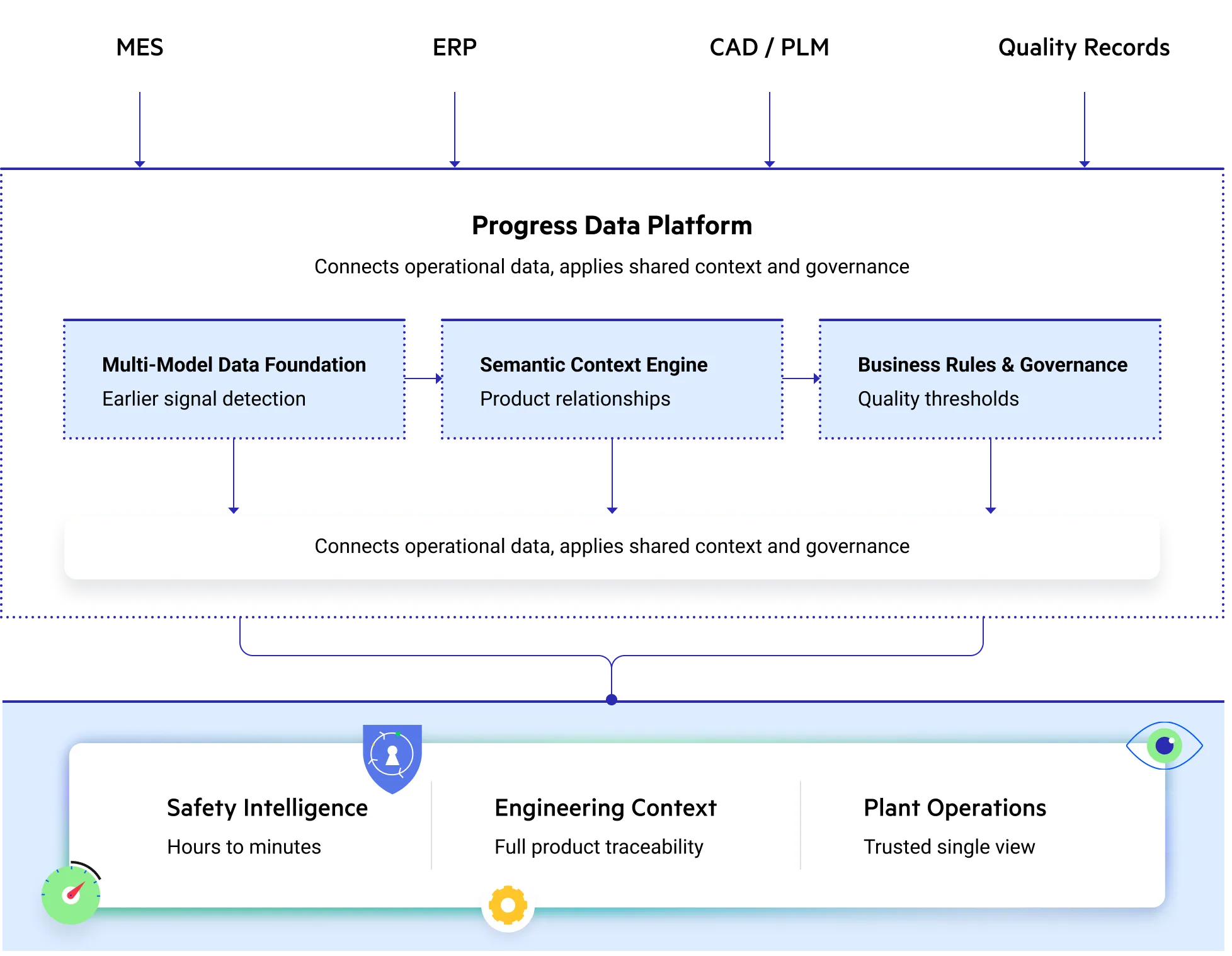
How the Progress Data Platform Delivers for Manufacturing & Engineering
The Progress Data Platform helps manufacturing and engineering teams work from one trusted foundation across operational data, engineering knowledge and business rules. It connects enterprise data, applies shared context and governance and makes trusted information available to the applications and services your people already use.
Multi-Model Data Foundation
Unifies engineering docs, specs and operational data across formats.
Semantic Context
Engine
Enriches manufacturing terminology and product relationships.
Business Rules & Governance
Enforces quality thresholds and compliance validation.
Build Your Expertise


FAQs

Make Production Decisions You Can Stand Behind
Talk with a Progress specialist about the operational, engineering or quality decision you need to get right, the first time.