
Better Patient Outcomes Start with Better Context
Healthcare systems and networks get the connected data, governance and trusted AI they need to support care teams, members and operations with confidence.
Trusted by


Care Quality Depends on the Context Your Data Carries
Healthcare organizations are under pressure to improve service, manage cost, support interoperability and use AI more effectively, all while working through privacy, regulatory and data quality demands. This gets difficult when administrative, claims, eligibility, clinical and content systems remain fragmented. The question is no longer whether AI will be part of healthcare operations. The real question is whether the underlying data and governance are strong enough to support safe, useful outcomes.
The Progress® Data Platform helps healthcare organizations create a more connected, reusable and governed foundation for AI, interoperability and operational improvement, so care teams, members and operations can act on a complete, trusted picture.
85%of surveyed healthcare leaders were exploring or had already adopted GenAI capabilities.
McKinsey Healthcare AI Survey, 2025
Why Companies Trust the Progress
Data Platform
Proof That Healthcare Teams Deliver Better Outcomes with Connected Context
 Customer Stories
Mississippi Division of Medicaid (MS DOM)
Consolidated administrative, claims, eligibility and clinical data into a single reusable foundation, cutting IT modernization costs to one-third of the original plan while accelerating compliance with federal CMS interoperability rules.- IT modernization costs cut to one-third of original plan
- Accelerated CMS compliance

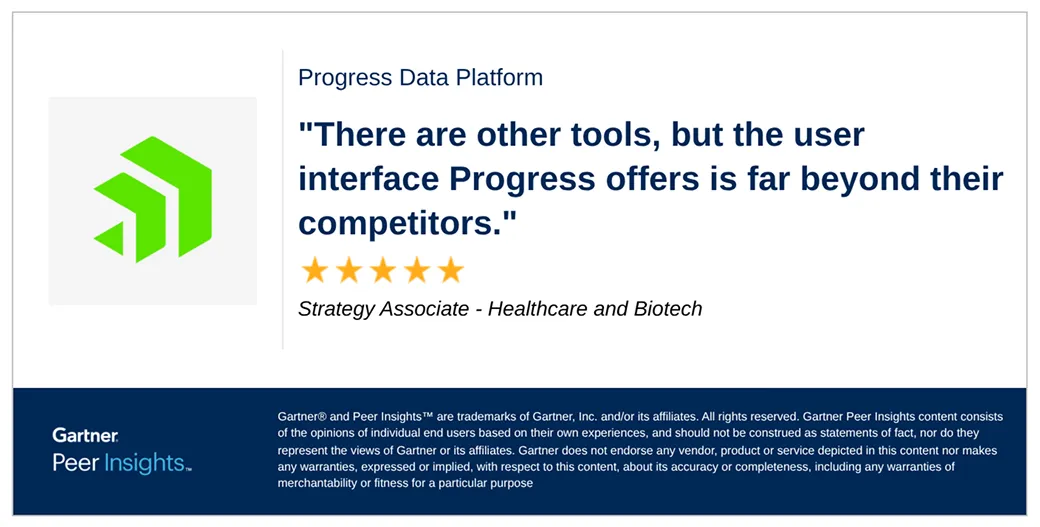
Validated by the Experts, Leading with Outcomes


Who This Is For

Needs a modern data foundation that supports interoperability and works with existing systems.

Needs faster access to the information behind service, coverage and care decisions.

Needs stronger control, lineage and policy awareness across data and AI outputs.

Needs clearer, more usable information without forcing teams into yet another disconnected workflow.
What Healthcare Teams Can Do with the Progress Data Platform
Build a Reusable Picture of the Patient and the Member
Connect claims, eligibility, administrative and clinical information in a single, usable layer, so teams work from a complete view, not a partial one.
How It Works
Supports aggregation, harmonization and richer context across healthcare data types and sources.
ExploreMississippi's Division of Medicaid consolidated administrative, claims, eligibility and clinical data into one reusable foundation
Modernize Without Ripping and Replacing
Move faster on compliance and data sharing without a risky full overhaul of the systems care and operations depend on today.
How It Works
Supports incremental modernization that works with existing systems, rather than replacing them.
ExploreMississippi's Division of Medicaid cut modernization costs to one-third of the original plan while accelerating CMS compliance
Answer Member and Care Questions the First Time
Help support and care teams answer questions faster and more accurately using natural language, not a training manual.
How It Works
Adds context across complex healthcare language, plans and source systems so queries map to the right answers.
ExploreSemantic search correctly maps “morning sickness” to maternity benefits for a top-ten payer
Put Defensible Context Behind Every AI Output
Make AI useful for high-value clinical and operational workflows, without losing control, compliance or auditability.
How It Works
Combines semantic context, governance and source traceability so outputs stay reviewable and defensible.
Explore10:1
efficiency improvements achieved by health plan using operational workflows powered by the Progress Data Platform
How the Progress Data Platform Delivers for Healthcare
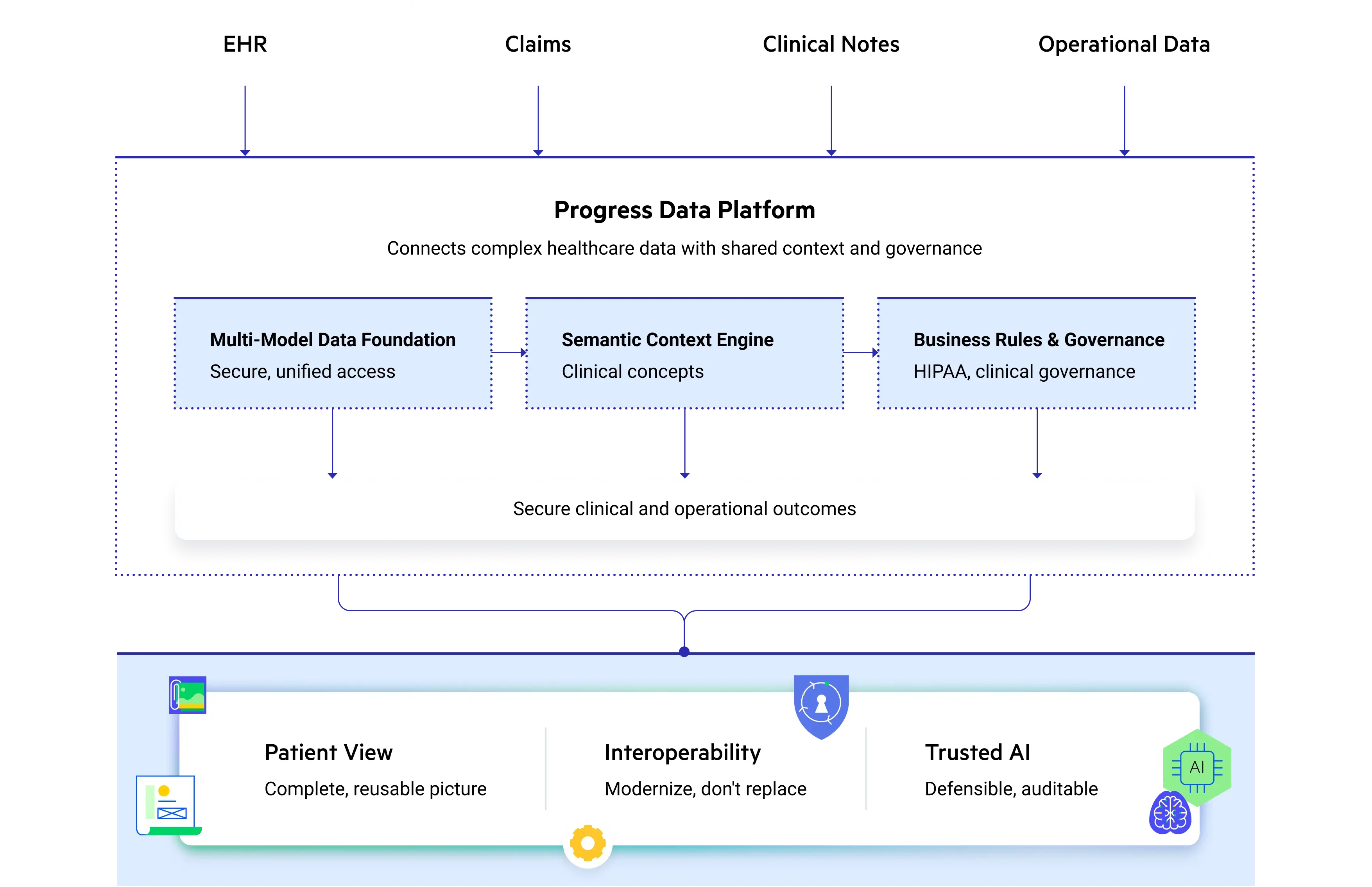
The Progress Data Platform helps healthcare organizations connect complex data, apply shared context and governance, and make trusted information available across the enterprise. It supports interoperability, better retrieval and more explainable AI, without asking teams to rip out the systems they depend on today.
Multi-Model Data Foundation
Unifies clinical, claims and operational data securely.
Semantic Context
Engine
Enriches medical terminology and clinical concepts.
Business Rules & Governance
Enforces HIPAA compliance and clinical governance.
Build Your Expertise



FAQs

Deliver Patient Outcomes Your Team Can Stand Behind
Talk with a Progress specialist about the clinical, member or operational outcome you want to improve, and how connected context can get you there.