Why Every Company Will Have Its Own Internal ChatGPT
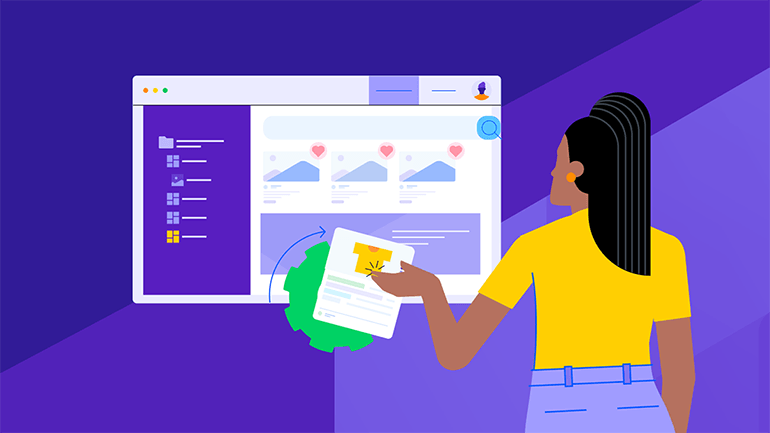
In the quest for leveraging data insights without exposing proprietary information, many companies are implementing RAG systems to query like an internal ChatGPT.
ChatGPT marked the beginning of a new era in workplace AI. Within months of its launch, teams across every industry started using it to draft emails, summarize reports and brainstorm ideas. It felt like magic.
But here’s the thing: public AI tools like ChatGPT only know what the internet knows. They can’t see your customer data, your internal reports or the product documentation sitting in your CMS. And when you paste sensitive information into a public tool to get better answers, you’re trading control for convenience.
That trade-off is why companies are now building their own internal AI assistants. Not as a replacement for ChatGPT, but as a private, domain-trained version that understands their business, helps protect their data and delivers answers grounded in what they actually know.
This is already taking shape inside many organizations. And if you’re not thinking about it yet, you’re about to be.
The Limits of Public AI Tools
Public AI tools are built on massive datasets scraped from the internet. That makes them incredibly useful for general knowledge tasks like writing a job description, explaining a concept or generating creative ideas.
But they fall short the moment you need something specific to your business.
- Ask ChatGPT about your Q3 sales pipeline, and it can’t help.
- Ask it to pull insights from your customer support tickets, and it has no idea what you’re talking about.
- Ask it to reference your company’s compliance documentation, and you’ll get a generic answer that may or may not apply to your situation.
The problem isn’t that ChatGPT is bad at its job. It’s that it wasn’t designed to do your job. It doesn’t have access to the context that makes your business unique, and uploading that context into a public tool introduces risk.
Every time you paste proprietary data into ChatGPT, you’re handing it over to a third party. Depending on your industry, that could violate compliance requirements, expose competitive intelligence, or simply make your legal team uncomfortable. And even if you trust the platform’s privacy policies today, those policies can change.
This is why companies are starting to ask a different question: What if we had our own AI that only knows what we want it to know?
What an Internal ChatGPT Actually Looks Like
When we talk about an internal ChatGPT, we’re not referring to a clone of the public tool. Rather, we mean a private AI assistant trained on your company’s data, designed to answer questions, surface insights and automate tasks using only the information you control.
Here’s what that looks like in practice:
- A sales team member asks, “Which case studies mention healthcare clients?” and gets an instant list with links (citations) to the original documents.
- A marketing manager queries, “What were the top customer complaints in Q2?” and receives a summary pulled directly from support tickets and feedback forms.
- A product team uploads a 50-page research report and asks, “What are the key findings about user retention?” The system highlights the relevant sections and generates a brief overview.
Instead of searching through folders, digging through emails or waiting on someone else to find the answer, your team gets what they need in seconds. And because the system only pulls from your verified sources, the answers are accurate, traceable and grounded in your reality. This is the difference between asking the internet a question and asking your own knowledge base.
Why Companies Are Building These Systems Now
The shift toward internal AI isn’t just about privacy or control, though those are critical. It’s about creating a competitive advantage that can’t be copied.
When everyone uses the same public AI tools, everyone gets similar outputs. Marketing copy starts to sound the same. Campaign strategies overlap. The insights you’re working from are the same ones your competitors are using.
But when your AI is trained on your customer interactions, your product history, and your internal research, the outputs reflect something no one else has: your unique business context.
That context is what makes personalization actually personal. It’s what allows you to build campaigns that reference real customer behavior, not assumptions.
And the timing makes sense. A few years ago, building something like this would have required a dedicated AI team, months of development, and a significant budget. Today, platforms like Progress Agentic RAG make it possible to set up your own internal AI system in hours, not months.
You don’t need to hire data scientists or rebuild your infrastructure. You just need to connect your existing data sources and start asking questions.
What This Means for Data Control
One of the biggest reasons companies hesitate to use AI is the fear of losing control over their data. And that fear is justified.
When you use a public AI tool, your data lives somewhere else. Even if the platform promises not to use it for training or share it with third parties, you’re still trusting an external entity with information that may be sensitive, proprietary or regulated.
An internal AI system flips that dynamic. Your data stays in your environment. You decide what gets indexed, who can access it and how it’s used. If a document needs to be removed or updated, you control that process entirely.
This level of control matters in industries like finance, healthcare and legal services, where compliance isn’t optional. But it also matters for any company that views its data as a strategic asset. Your customer insights, your product roadmap, your competitive intelligence—these aren’t things you want floating around in someone else’s cloud.
With an internal system, you get the benefits of AI without the trade-off. You can automate workflows, surface insights and empower your team to move faster, all while keeping your data exactly where it belongs.
How Progress Agentic RAG Makes This Simple
Building an internal AI assistant used to mean hiring a team of engineers, choosing between a dozen different tools, and spending months on configuration. Progress Agentic RAG changes that.
It’s designed as a modular RAG-as-a-Service platform, which means you get the infrastructure, AI agents and customization options you need without having to build it all from scratch.
Here’s how it works:
- Ingest your data: Connect your CMS, upload PDFs, link to your knowledge base or sync entire folders. Progress Agentic RAG handles almost any format, from documents and videos to spreadsheets and slide decks.
- Enrich with AI agents: The platform uses specialized agents to classify content, extract entities, generate summaries, and build knowledge graphs. This means your data doesn’t just sit there; it becomes searchable and actionable.
- Define your retrieval strategy: Choose how the system finds and ranks information. You can customize chunking strategies, test different embedding models and fine-tune retrieval methods to fit your use case.
- Connect any LLM: You’re not locked into a single language model. Switch between OpenAI, Anthropic, Google Gemini or others depending on what works best for your workflow.
- Evaluate quality: Progress Agentic RAG includes REMi, a proprietary evaluation model that scores outputs for relevance, accuracy and grounding. This helps your team get reliable answers that are traceable back to the source.
The setup doesn’t require IT intervention for day-to-day use. Once your data is indexed, your team can start querying it immediately. And because the system is modular, you can start with one use case, like internal search and expand to others, like customer-facing chatbots or content repurposing, as you see the value.
Where This Goes Next
The companies that move early on internal AI won’t just save time or reduce risk. They’ll build a foundation that gets smarter the more it’s used.
Every question your team asks, every document you upload, every workflow you automate, it all feeds into a system that becomes more useful over time. And because it’s trained on your data, the value compounds in ways that public tools can’t replicate.
So the question isn’t whether your company will eventually build this. It’s whether you’ll do it now, while it’s still a competitive advantage, or later, when it’s just the baseline.
If you’re ready to see what an internal AI assistant could do for your team, try Progress Agentic RAG now or book a demo to explore how it fits into your workflow.
And now, you can use the insights of Progress Agentic RAG inside your website: Progress unveiled the first Generative CMS. Progress Sitefinity CMS powered by Progress Agentic RAG transforms enterprise knowledge into adaptive experiences—each assembled in real time by AI that understands your users, your brand and your goals.
Request a demo for Sitefinity Generative CMS and get started with your own innovations.
Enjoyed this article?
Add Progress as a preferred source to see more of our content in Google search.
Add Progress as a preferred source on Google
John Iwuozor
Content Lead