We are witnessing a fundamental shift in how people seek and engage with information. Generic experiences no longer resonate. Users now expect interactions that feel relevant, contextual and conversational.
Download the Field GuideWhy traditional websites fall short
Traditional websites that rely on static navigation and menu clicks are giving way to systems that deliver direct, conversational responses, meeting users where they are instead of asking them to search. Search itself has evolved into dialogue, where people expect natural, contextual answers instead of rigid keyword matches.
So this begs the question: Is your traditional Content Management System(CMS) capable of delivering the experience your customers demand?
The answer is a resounding “No.” As digital experiences evolve to be adaptive and dynamic to meet customer demands, your CMS must evolve as well. It needs to be capable of producing context-aware and compliant experiences that meet user expectations while maintaining trust and governance in the age of intelligent, conversational systems.
What’s inside the Field Guide
This Field Guide to Generative CMS is designed to provide you with the key components you should look for when choosing a Generative CMS. It is not exhaustive by any means. It is a list of the critical elements you should consider.
As you embark on the journey to a modern Generative CMS, make sure the platform you choose provides you with these 14 foundational elements.
1. Dynamic Experience Assembly
Dynamic assembly lets the CMS adapt layouts, components and narratives for each user on the fly without reliance on brittle, rule-based logic. It leverages AI context, real-time behavior analytics and modular content, reducing manual design updates and enabling continuous, optimized experiences.
2. Real-Time Adaptation
A Generative CMS responds instantly to changing user intent, evolving sessions and context signals. Real-time adaptation uses analytics and session data, optimizing what users see and how they navigate, interact and receive recommendations.
3. Agentic RAG Integration
Agentic Retrieval-Augmented Generation (RAG) pairs autonomous agents with dynamic knowledge retrieval to deliver context-aware, verified and traceable responses. Answers come from approved and current sources, supporting reliability and auditability, which matters when inaccurate output could damage reputation or create liability.
4. Brand Guardrails
Content generated by AI must reflect approved brand voice, align with legal and regulatory standards and help mitigate reputational risks. Guardrails support real-time governance of tone, terminology and regulatory alignment, reducing risk of bias, off-brand messaging or regulatory missteps.
5. Source Traceability
Traceability connects generated content and answers to original sources for verification, quality control, compliance audits and reliable edits. Automated source tracing supports transparency and enterprise trust, particularly in regulated industries.
6. Integrated Analytics and Insights
Real-time, privacy-oriented analytics provide insight into content effectiveness, personalization strategies and audience behavior. Reporting, audit trails and engagement data support compliance, refinement and ROI measurement within the CMS.
7. Automated Content Classification and Metadata Intelligence
Automated content classification using natural language processing (NLP) and machine learning enables granular organization, reuse and compliance, while supporting dynamic personalization and content acceleration.
8. Automated Tagging, Linking and SEO
A Generative CMS should automatically apply metadata, create contextual links and optimize for search engines without manual intervention. Automated tagging and linking keep content organized and discoverable, improving user experience and search performance.
9. GEO Optimization
Generative Engine Optimization (GEO) helps AI-driven bots, search engines and digital assistants discover, summarize and recommend your content. It focuses on metadata, topic templates and Q&A generation and search engine-specific cues so your organization remains visible to emerging AI search platforms.
10. Assistive Creation and Collaboration
AI-driven assistance offers contextual suggestions, assesses quality and facilitates collaborative workflows. Integrated planning and campaign management tools help teams coordinate and align cross-channel experiences.
11. Multilingual AI Search
Native language AI search expands reach and accessibility for global audiences. A Generative CMS must interpret conversational voice search and long-tail intent in many languages, supporting localized, context-rich experiences.
12. Enhanced Chatbot and Conversational Interfaces
AI-powered chatbots and virtual assistants improve engagement and support, transforming interactions with content into rich conversations that drive satisfaction and conversions. These features require analytics to track quality, accuracy and sentiment in user exchanges.
13. Generative UI and Visual Editing
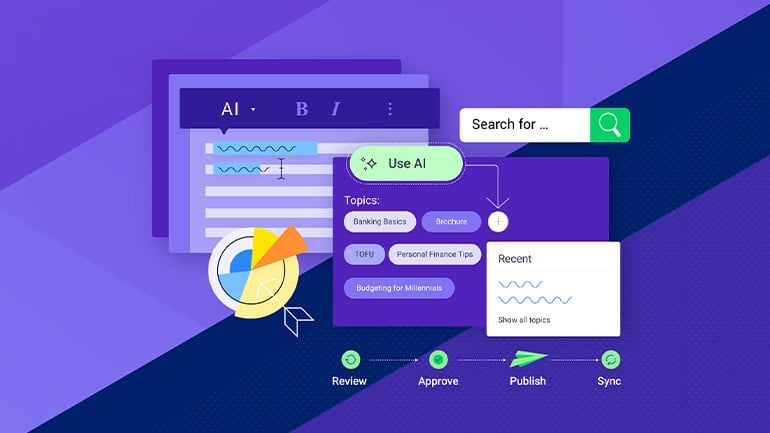
Modern Generative CMS platforms are beginning to embed design-to-code and visual editing, letting creators use drag-and-drop AI design tools for page updates with less reliance on developers. This speeds iteration and innovation.
14. Support for Diverse Content Types (3D, AR/VR, Interactive)
Future-facing Generative CMS platforms will increasingly handle advanced media such as interactive experiences, AR/VR and 3D model content for richer engagement and accessibility.
Want the full context, examples and complete write-up for each capability? Download the full Field Guide .
Generative CMS Capabilities Checklist
No field guide would be complete without a ready-made checklist. As you evaluate your Generative CMS options, keep this list handy. Download the full checklist in the PDF for a printable version.
- Dynamic Experience Assembly: AI-driven layouts adapt to each user, eliminates rigid rule-based personalization, enables continuous optimized experiences
- Real-Time Adaptation: Instantly adjusts to changing user intent, optimizes navigation, interaction and recommendations, improves conversion and satisfaction
- Agentic RAG Integration: Combines retrieval-augmented generation with autonomous agents, provides verified traceable and current responses, supports trust and alignment in regulated sectors
- Brand Guardrails: Enforces tone, terminology, compliance standards, reduces reputational and legal risk, maintains brand consistency at scale
- Source Traceability: Links generated content to verified sources, enables audits and transparent processes, builds enterprise-wide trust and accountability
The PDF includes the complete 14-point checklist: Download the checklist and full Field Guide .
Introducing the First Generative CMS Built on Trusted AI
Progress Sitefinity Powered by Progress Agentic RAG
Think a Generative CMS is right for you? Explore Progress Sitefinity CMS, the first Generative CMS built on trusted AI. Powered by Progress Agentic RAG, Progress Sitefinity combines enterprise-grade RAG intelligence with dynamic experience generation, enabling marketers to transform siloed content and data into conversational, hyper-personalized and continuously optimized digital experiences without complex rules.
How does Generative CMS differ from Traditional CMS and DXP?
A traditional CMS or Digital Experience Platform (DXP) is like a control center for digital customer touchpoints, helping teams manage, optimize and personalize experiences. A Generative CMS powered by Agentic RAG uses advanced AI agents to generate content, search for up-to-date information, plan tasks and interact with external sources or APIs as needed. It can break complex workflows into smaller steps, reason through tasks and produce uniquely tailored real-time content across platforms.
| Category | Traditional CMS and DXP | Generative CMS Powered by Agentic RAG |
|---|---|---|
| Scope | Orchestrates digital experiences and journeys across channels | Connects content through retrieval strategies for real-time adaptive experiences and journeys |
| Core functionality | Combines content, personalization, analytics and user data | Uses AI agents for live information retrieval and reasoning |
| Content creation | Manages static and manually created content | AI agents generate content automatically |
| Content retrieval | Static, stored in the database | Agents actively search and fetch latest info |
| Architecture | Monolithic, tightly coupled front and back end | Modular, agent-driven workflows |
| Personalization | Uses customer data for automated personalization at scale | Real-time dynamic, driven by agent reasoning |
| AI capabilities | Primarily automation, analytics and content creation | Autonomous agents that plan, act and reason independently |
| Scalability | Challenging for complex needs | Less manual content creative and managed by AI |
Learn more about Sitefinity Generative CMS
Join the Sitefinity Generative CMS Get Started with Sitefinity Generative CMS .