What Makes an AI System ‘Agentic’?

What does the term “agentic” or “agent” mean in AI? How is it different from “predictive AI”? How does any of this apply to your business? This post breaks it down.
If you’ve spent any time reading about AI lately, you’ve probably seen the word “agentic” pop up everywhere. Agentic AI. Agentic workflows. Agentic systems.
It sounds impressive, but what does it actually mean?
Most people assume it’s just another way to describe AI that does things automatically. But that’s not quite right. An agentic system doesn’t just follow instructions or predict the next word in a sentence. It acts with purpose, adapts to changing conditions and reasons through problems using the context it has available.
The difference matters because it changes what AI can do for your business. This article breaks down what makes a system truly agentic and why that distinction is worth understanding.
The Difference Between Predictive AI and Agentic AI
To understand agentic AI, it helps to start with what it’s not.
Traditional AI systems, including most large language models, are predictive. You give them a prompt, and they generate a response based on patterns they’ve learned from training data. They’re incredibly good at this, but they don’t actually think through a problem or adjust their approach based on new information.
Ask ChatGPT to summarize a document, and it will. Ask it to find three related documents, compare their conclusions and suggest which one is most relevant to your current project, and it struggles. It can’t navigate between tasks, evaluate its own progress or decide what to do next.
That’s where agentic systems come in.
An agentic AI system can break down a complex request into smaller steps, use tools to gather information, evaluate what it finds and adjust its approach as it goes. It doesn’t just predict, it acts, adapts and reasons.
According to McKinsey’s 2025 report, early adopters are already using agents to run multi-step, decision-heavy workflows that manual processes and Gen AI tools can’t handle.
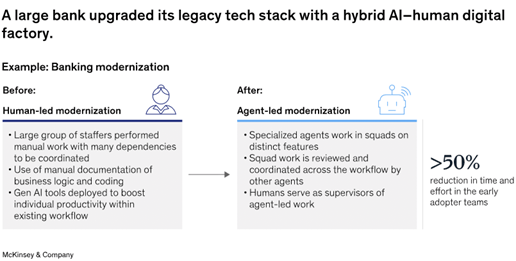
In practice, this includes more than a 50% reduction in time and effort for a bank modernizing a 400-system legacy stack, and over 60% potential productivity gains and $3 million in annual savings in a market-research data pipeline.
This marks a structural shift, one in which AI is moving from reactive prediction to autonomous execution, where agents navigate tasks, make decisions and coordinate entire processes across systems.
What It Means to ‘Act’ vs. ‘Predict’
Let’s make this concrete.
Imagine you ask a traditional AI, “What were our top-performing campaigns last quarter?” If the information isn’t already in the prompt you gave it, the AI can’t do anything. It might give you a generic answer or tell you it doesn’t have access to that data.
Now imagine asking the same question to an agentic system connected to your CMS and analytics tools.
The system doesn’t just respond with what it already knows. It takes action. It queries your CMS for campaign data, pulls performance metrics from your analytics platform, ranks the results by engagement or conversion, and then presents a clear answer with links back to the original sources.
That’s the difference. One system waits for you to provide everything it needs. The other goes out and gets it.
This ability to act, to use tools, retrieve information and execute steps autonomously, is what makes a system agentic. It’s not just smarter; it’s more capable because it can work with the world around it.
How Agentic Systems Adapt
Agentic AI doesn’t follow a rigid script, rather it adapts based on what it finds.
Let’s say you ask an agentic system to generate a report on customer feedback trends. A predictive AI might summarize whatever text you paste into it. But an agentic system takes a different approach.
First, it searches your knowledge base for customer feedback data. If it finds structured survey results, it analyzes those. If it also finds unstructured support tickets, it pulls insights from those too. If certain feedback mentions a product issue, it might cross-reference that with your product documentation to see if there’s a known fix.
At each step, the system evaluates what it’s found and decides what to do next. It doesn’t just execute a predetermined sequence. It reasons through the task, adjusting based on the information available.
This adaptability is what allows agentic systems to handle ambiguous or open-ended requests. You don’t need to break everything down into precise instructions. The system figures out the best path forward on its own.
Reasoning with Context, Not Just Keywords
One of the most important qualities of an agentic system is its ability to reason using context, not just match keywords.
Traditional search works by looking for exact terms or close variations. If you search for “pricing strategy,” you’ll get results that mention those words. But you won’t necessarily get the insights that matter, like which pricing models performed best with a specific customer segment or how your pricing compares to competitors.
An agentic system understands the intent behind your question. It doesn’t just look for keywords. It considers the context, the relationships between different pieces of information and what you’re actually trying to accomplish.
For example, if you ask, “Why did conversions drop in March?” an agentic system doesn’t just pull up documents that mention March or conversions. It looks for patterns, campaign changes around that time, shifts in traffic sources, updates to your product pages, anything that might explain the trend. Then it synthesizes that information into a coherent answer.
This kind of reasoning is what separates basic automation from agentic intelligence. It’s what allows these systems to handle complex, nuanced questions that don’t have simple, one-step answers.
The Role of AI Agents in Agentic Systems
So how do agentic systems actually work? The answer is AI agents.
An AI agent is a specialized component designed to handle a specific task within a larger workflow. Instead of one monolithic AI trying to do everything, an agentic system uses multiple agents, each with its own role.
For instance, in Progress Agentic RAG, different agents handle different parts of the data pipeline:
- Labeler agents that classify and tag content automatically, enabling more efficient retrieval.
- Graph-extraction agents that identify entity relationships and build a knowledge graph from your data.
- Q&A-generation agents that extract potential questions and answers from your content to improve discoverability.
These agents work together, coordinating their actions to accomplish tasks that would be impossible for a single predictive model. And because they’re modular, you can customize how they operate to fit your specific needs.
Why ‘Agentic’ Matters for Your Business
The shift from predictive to agentic AI actually changes what AI can actually do for your team.
A recent Gartner analysis projects that by 2028, at least 15% of day-to-day work decisions will be made autonomously through agentic AI, up from 0% in 2024. This rapid adoption reflects how quickly businesses are recognizing the value of systems that can reason and act independently.
With predictive AI, you’re limited to tasks that fit into a single prompt-and-response cycle. Summarize this. Draft that. Answer this question based on what I just gave you.
With agentic AI, you can delegate entire workflows. Find the relevant data. Analyze it. Compare it to last quarter. Identify trends. Generate a report. And do it all without needing someone to manually guide each step.
That’s the difference between a tool that assists and a system that operates.
For marketing teams, this means faster campaign analysis, smarter content repurposing and the ability to pull insights from data that would otherwise sit unused. For sales teams, it means instant access to case studies, competitive intelligence and customer history without digging through files. For support teams, it means faster resolutions and fewer repetitive questions.
And because agentic systems work with your private data, the insights they surface are grounded in your reality, not the internet’s best guess.
What This Means Going Forward
Agentic AI isn’t a buzzword. It’s a shift in how AI systems are designed and what they’re capable of doing.
As these systems become more capable, the companies that adopt them early will have a significant advantage. They’ll move faster, make better decisions and build workflows that scale in ways manual processes never could.
If you’re ready to see what an agentic system can do with your data, try Progress Agentic RAG now or book a demo to explore how it fits into your workflow.
And now, you can use the insights of Progress Agentic RAG inside your website: Progress unveiled the first Generative CMS. Progress Sitefinity CMS powered by Progress Agentic RAG transforms enterprise knowledge into adaptive experiences—each assembled in real time by AI that understands your users, your brand and your goals.
Request a demo for Sitefinity Generative CMS and get started with your own innovations.

John Iwuozor
Content Lead