How to Get Cited in AI Overviews: A Practical Guide

Sitefinity CMS improves SEO and AIO performance with answer-first content, precise metadata, semantic structure, internal linking and structured data. To understand why this matters, we need to start with why AI systems ignore most content.
Why AI Systems Ignore Most Content
AI systems ignore content that leads with brand voice instead of answers. A language model does not read pages the way a person does. It scans for the clearest, most direct response to a query. If that response is not near the top, the model moves to a page that puts it there.
A financial services page that opens with "We are proud to offer comprehensive solutions" will never be cited. A page that opens with "A fixed-rate mortgage locks your rate for the life of the loan" will be cited every time someone asks that question. The difference is not quality. It is structure.
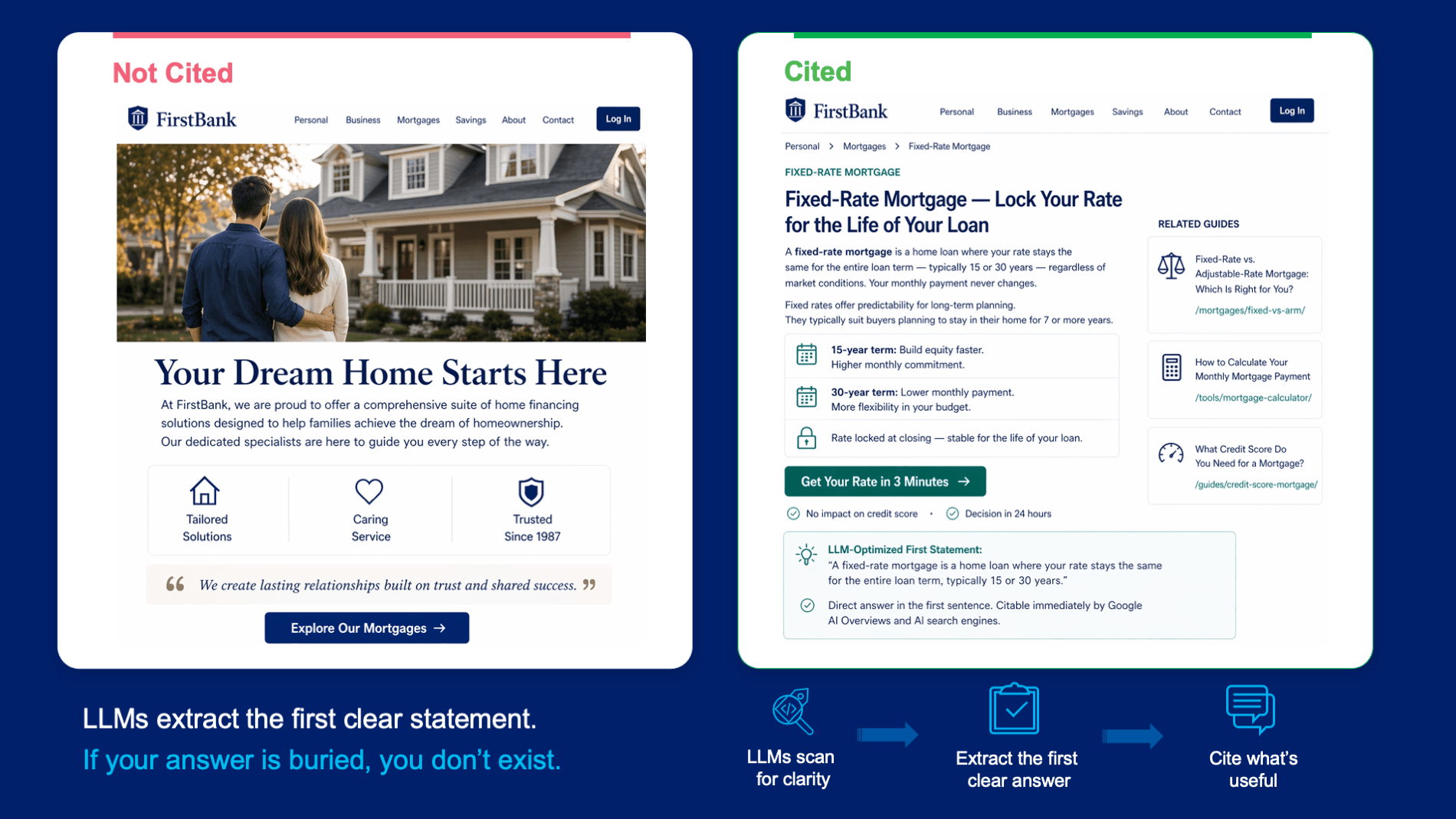 An audit of enterprise CMS implementations found that roughly 80% of sites open with generic messaging — "leading provider," "trusted partner," "over X years of experience." These pages answer no question. They get no citation.
“80% of enterprise sites open with generic messaging. They answer no question. They get no citation.”
LLMs are extraction engines. They pull the answer from wherever it appears first. Your page is either answer-first or invisible.
The Five Things LLMs Actually Look For
AI citation optimization depends on five structural factors: answer-first writing, semantic heading hierarchy, descriptive internal links, FAQ sections and schema markup.
- Answer-first structure. The first sentence answers the question. Context, history and caveats come after. If you open with background, you lose the citation before the machine reads the second line.
- Semantic heading hierarchy. Your H1 names the topic precisely. Your H2s name the sub-topics. If a widget or template component outputs a second H1, you have competing signals. The machine cannot resolve them. It skips the page.
- Descriptive internal links. Anchor text tells the machine what the destination covers. "Click here" and "learn more" carry zero information. "Flow rate calculation for centrifugal pumps" carries specific, indexable meaning.
- FAQ sections with direct answers. Each FAQ is a discrete, citable unit. The answer must start with the answer — not with "Great question" or "There are several factors to consider." One sentence. The fact. Done.
- Schema markup. FAQ schema, Article schema, Product schema. Structured data hands the machine what it needs without interpretation. Pages with schema get cited at higher rates than pages without it. This is not a theory.
“A page with all five factors will outperform a page with three. They compound.”
The CMS Problem Nobody Talks About
Most SEO failures are template failures, not content failures. The editor writes a good answer. The CMS buries it under a hero widget. The H1 is hardcoded to the brand tagline. The canonical tag points to the wrong URL. The editor never sees any of this.
We analyzed 15 enterprise websites across industries, scoring each against six criteria: meta tag quality, H1 and H2 structure, canonical configuration, alt text usage, text-to-code ratio and content layout. The findings were consistent enough to be a pattern, not a sample error.
Every site had basic SEO in place — meta tags, analytics, tracking and canonical tags. That is the floor, not the ceiling. 80% opened with generic messaging: "leading provider," "trusted partner," "over X years of experience." H1 and H2 structures were weak or inconsistent across the board, with almost none aligned to search intent. Alt text was minimal — limited to logos or generic labels where it existed at all. Advanced structured data was present but inconsistent, an underused opportunity on nearly every site. And zero percent had any personalization or AI-driven content structure.
“Every site was technically compliant. And that was the only good news. Zero percent was built to be understood by AI.”
These are not editorial failures. Editors cannot fix what the template controls. This is an architectural problem.
A parts catalog with 10,000 product pages cannot be fixed page by page. Each one needs a specific H1, correct alt text, a canonical tag and schema. You train your way to nothing at that scale. You configure your way to it.
Sitefinity CMS lets you set canonical defaults, metadata templates and schema markup at the content type level. Every page published under that type is correct from the start. One configuration. Ten thousand correct pages.
Fix the template. The content follows.
What a Citable Page Actually Looks Like
A citable page answers the question in the first sentence, uses a specific H1 and structures every supporting element to reinforce that answer. Here is what that looks like in practice.
Take a fictional product page: the CS-200 Industrial Pump. A weak version leads with "Premium Industrial Solutions — built for demanding environments." The audit found this pattern on the majority of enterprise sites reviewed. No citation. Ever.
A citable version looks like this:
- H1: CS-200 Centrifugal Pump — 50 GPM, 316 Stainless Steel, ANSI/HI Compliant
- First paragraph: The CS-200 delivers 50 GPM at 75 PSI and handles corrosive process fluids up to 250 degrees Fahrenheit. It meets ANSI/HI 9.6.1 standards for industrial pump installation.
- Spec chips: Three numbers that matter — flow rate, pressure and temperature rating.
- Related resources: Anchor text like "centrifugal pump sizing guide" and "corrosion-resistant materials comparison," not "other products" or "learn more."
- Alt text: "CS-200 centrifugal pump, 50 GPM, 316 stainless steel housing, front view" — not "image001."
- Schema: Product schema marking up the specifications the machine needs.
“Our Premium Industrial Solutions — built for demanding environments.”
A page with such messaging will never be cited. Not because the product is bad. Because the page never answered a question. Let's look at an alternative approach.
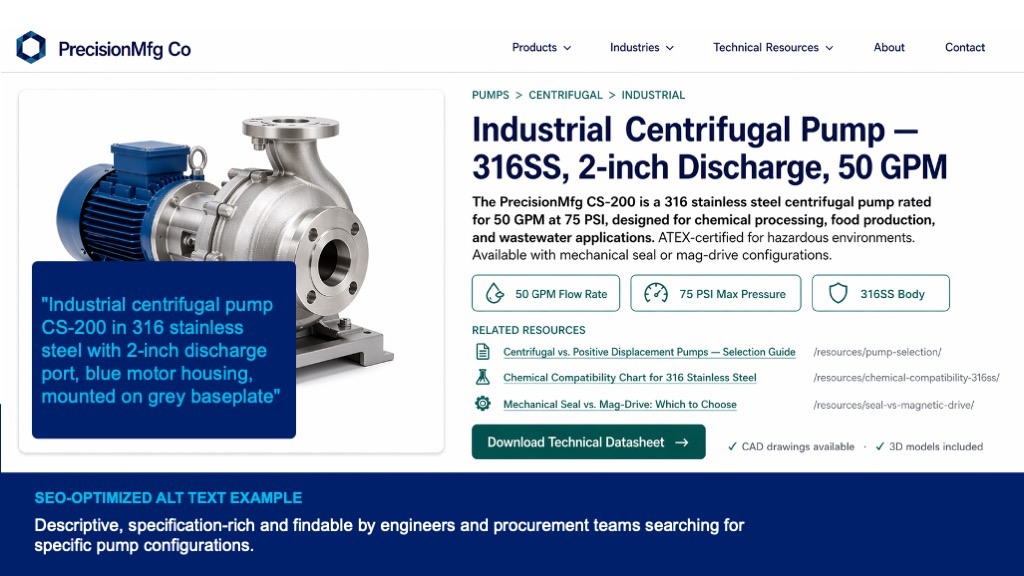
That page answers the question before the reader scrolls. It gets cited. Simple and easy to replicate.
The FAQ Shortcut
FAQs are the single fastest way to increase your AI citation rate. Each FAQ is a self-contained answerable unit. The machine pulls it directly, without needing to parse surrounding context.
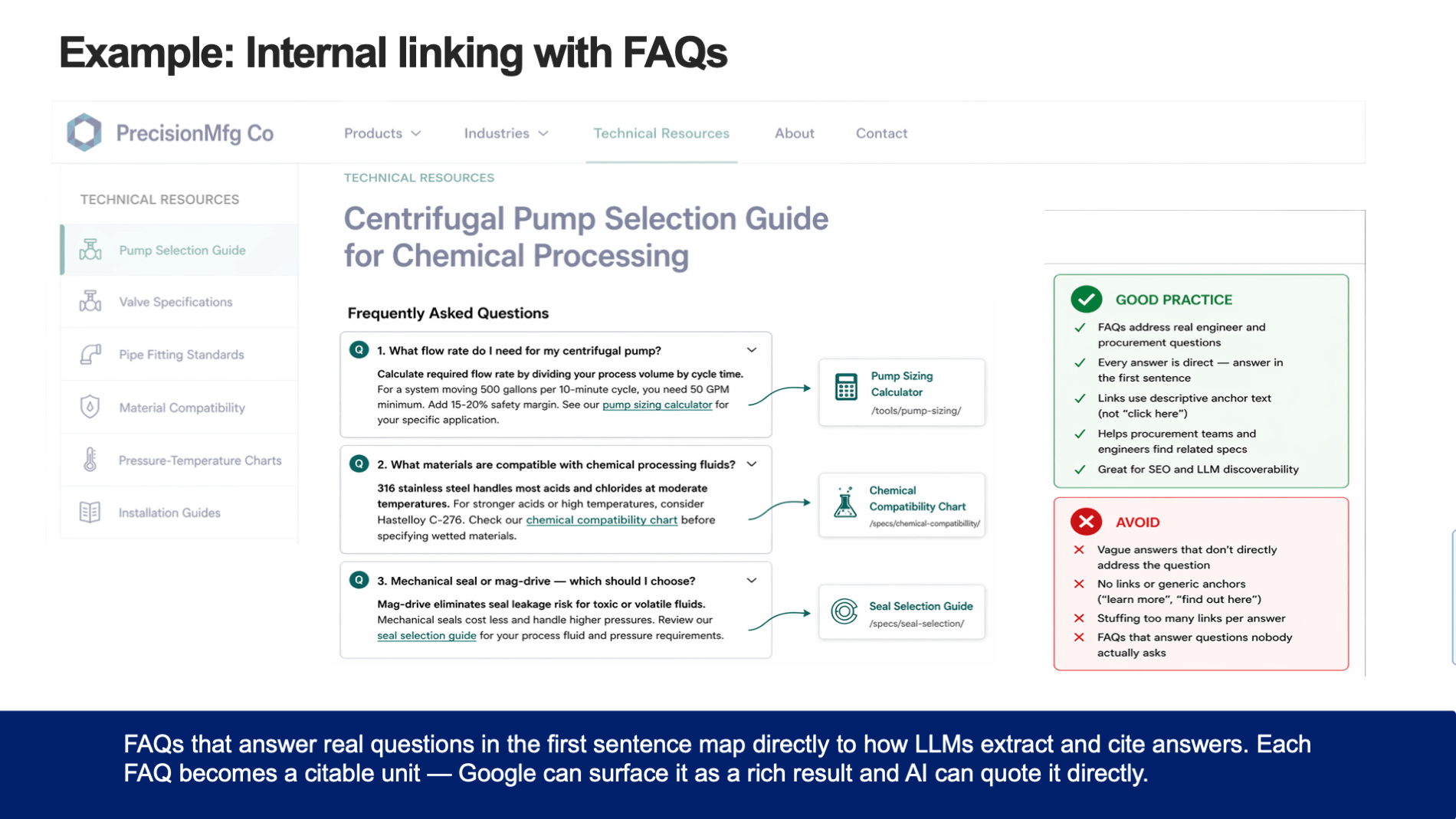
The rule is strict: the answer starts in the first sentence. Every time. No introduction. No "it depends." State the fact, then qualify if you must.
Every FAQ should also link to a related resource using descriptive anchor text. This tells the machine what your site covers. It builds topical authority that increases citation probability across the entire domain.
Add FAQ schema. It marks each answer as machine-extractable. Pages with FAQ schema appear in AI Overviews at rates that pages without it cannot match.
“Each FAQ is a citable unit. The machine pulls it directly. No parsing required.”
Here are two FAQs written for citation — in a manufacturing context:
Q: What flow rate do I need for a centrifugal pump? A: Divide your process volume by your cycle time. A system moving 500 gallons every 10 minutes needs 50 GPM minimum. Add 15% to 20% for safety margin.
Q: What materials handle corrosive process fluids? A: 316 stainless steel handles most acids and chlorides at moderate temperatures. For stronger acids or high heat, use Hastelloy C-276. Check chemical compatibility before specifying wetted materials.
Both answers start with the answer. Both are citable the moment they are published.
One Change That Fixes Everything
The single highest-impact change is moving SEO configuration from page-by-page editing to content-type-level architecture. Everything else is maintenance. This is the fix.
An audit of enterprise CMS implementations found that zero percent of sites had content structured for AI parsing or citation. Not a few. None. Every site was built to exist — not to be understood, extracted or cited by a machine.
“Zero percent of enterprise sites audited had content structured for AI parsing or citation. Not a few. None.”
You cannot manually correct 10,000 pages. The math does not work. Meanwhile, the template generates new broken pages every day.
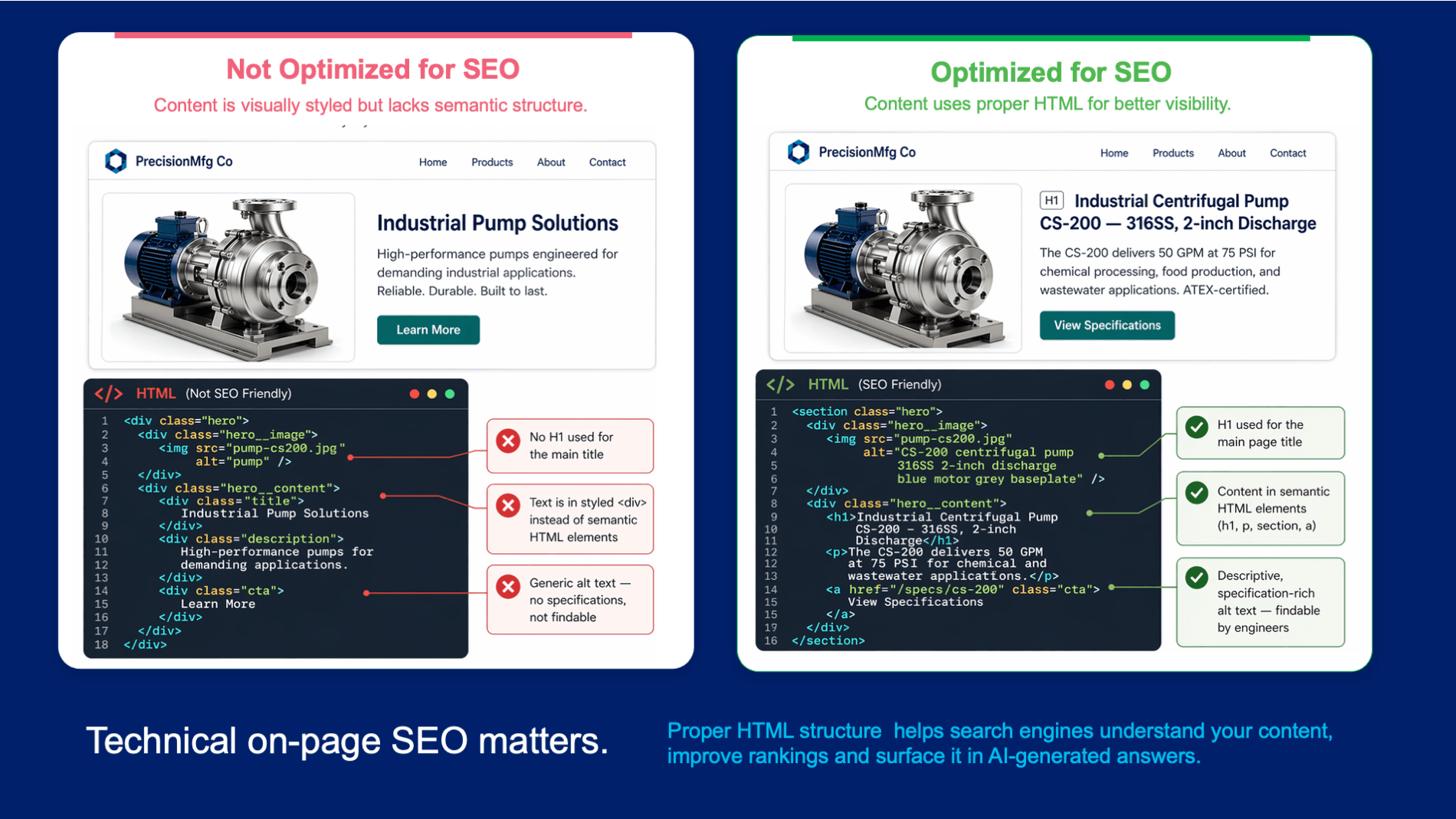
Configure the template correctly once. Every page it generates is correct. Canonical rules, metadata templates, schema markup and heading hierarchy — set at the architectural level, applied automatically across every published page.
This is what the Sitefinity platform enables — canonical rules, metadata templates, schema markup and heading hierarchy set once at the architectural level.
For existing content, AI agents can audit alt text, generate missing metadata and flag thin or duplicate pages — automatically, across thousands of entries.
If you want to see exactly what this looks like in a live Sitefinity CMS implementation, the webinar recording walks through each configuration step.