Why the Way You Power AI and What You Feed It Determine the Outcomes You Get

As organizations have begun to adopt AI across search, copilots, assistants and internal tools, expectations have run high. With access to years and shared drives full of documents, files, emails and knowledge repositories, it felt logical to assume that AI would instantly deliver smarter answers and better decisions right away.
After all, the data already existed, but it included unstructured documents, outdated files, duplicated content and siloed sources. With the job of combing through all of this, AI didn’t know what mattered most or what should be trusted. It simply worked with whatever it was fed.
And it quickly became apparent that organizations using large volumes of unstructured data weren’t struggling because of scale, they were struggling because their AI had no sense of balance.
Important knowledge was buried under noise. Context was missing. Relevance was inconsistent. Teams hesitated to rely on AI outputs without manual verification. This led to results that often fell short, responses that lacked clarity and insights that felt disconnected.
How Do We Go Beyond AI with Gumption to the Power of Consumption?
Over time, this has become an accepted reality: when answers aren’t quite right, teams blame the model, the prompt or the tool. But some organizations working with unstructured data began thinking differently and recognized that improving AI outcomes doesn’t always require new tools or bigger investments.
Instead, it often starts with data awareness: understanding how data flows, how it’s maintained and how it’s consumed. Meaning the issue isn’t data intelligence, it’s data nutrition.
Just as humans are affected by their daily diet, AI reflects the data habits of the organization behind it. AI outcomes are shaped not just by large language models (LLMs), but by the quality, relevance, groundedness and structure of the data that the AI can consume. But LLMs lack the ability to consume data, and this is when agentic retrieval-augmented generation (RAG) enters the building.
This reframing has changed the conversation. The challenge wasn’t about having more data, it was about feeding AI with better and smarter data. The conversation moved away from “Why is AI wrong?” to “What are we giving it to work with?”
Why Does RAG Matter?
The goal isn’t to overwhelm AI with everything; it’s to help it work with what matters. The Progress Agentic RAG solution has become part of this mindset shift—not as a silver bullet, but as a practical way to help AI engage more intelligently with the information enterprises already have.
Because AI reflects its inputs, the models need to be kept up to date. The Progress Agentic RAG solution addresses this with the ability to ingest 30+ different file types, automatically structure the data and serve as a guiding layer that only requires the ability to tune your AI experiences to match how you’d like to receive answers.
Rather than treating data as a static repository, agentic RAG technology keys in on how information is retrieved, contextualized and delivered at the exact moment it’s needed. It also recognizes that unstructured data is valuable—but only when it’s accessed intentionally, responsibly and reliably.
So when the AI performs well, it’s because the underlying information is relevant, current and unsiloed, but when it does struggle, the problem is easier to understand and fix.
By improving how AI interacts with unstructured data, organizations can move away from guesswork and toward more dependable outcomes—without changing how people already work. And understanding this doesn’t require deep technical expertise; both technical and non‑technical stakeholders can finally discuss AI effectiveness using shared language, without getting lost in complexity.
Curious About How Your Organization Is Feeding Its AI?
Before changing tools or strategies, it can help to pause and take stock.
If you’re curious about how your organization is feeding its AI today, and what that might mean for the outcomes you’re seeing, you can explore this through a short, self‑guided quiz.
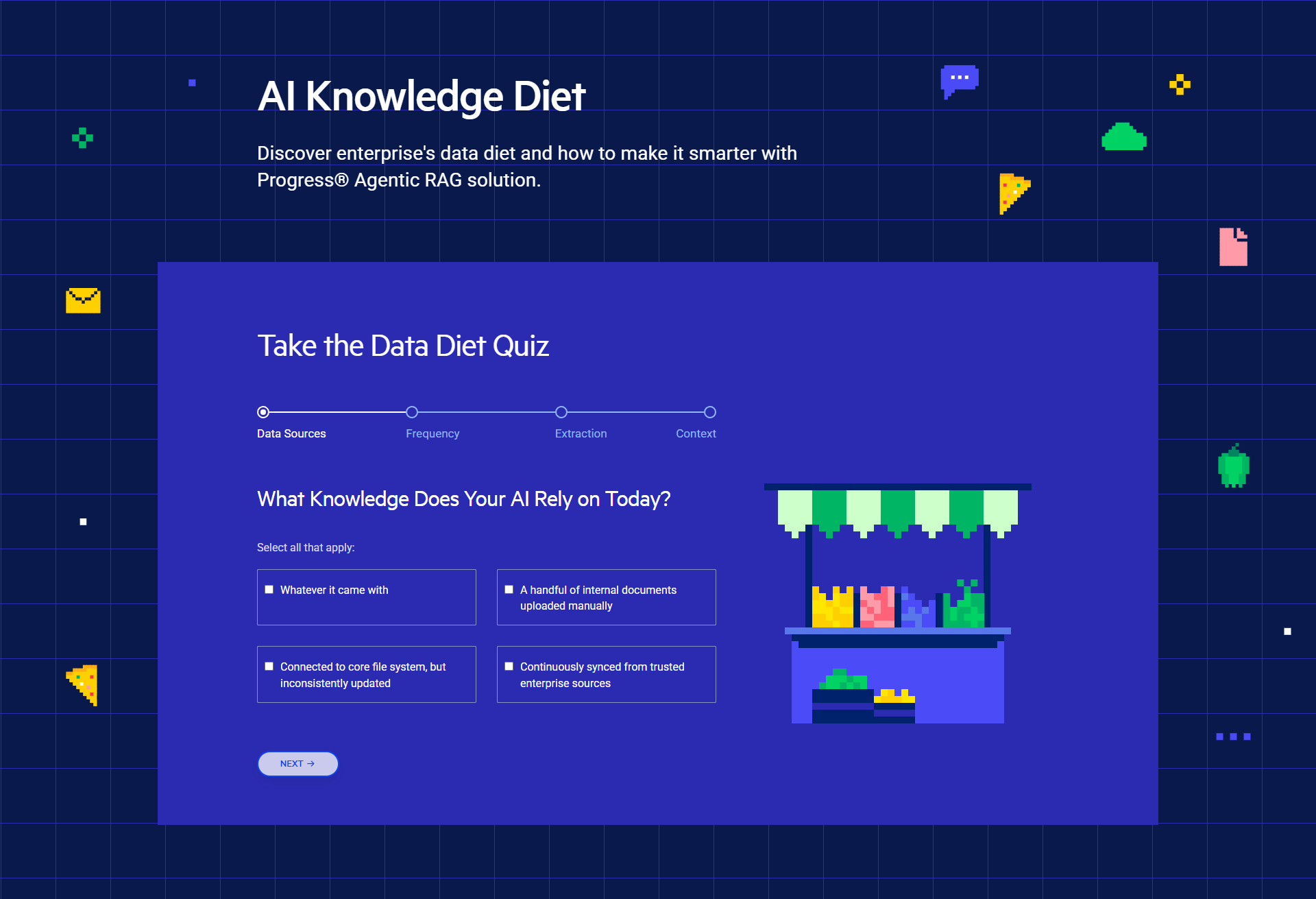 explore the quiz
The quiz is designed to help you reflect on your current data habits and understand the overall health of what your AI is consuming.
They say you are what you eat, but when it comes to AI, it is what you feed it.

Ashish Jain
Campaign Lead, Senior