Rubber, meet road: The challenge for application development companies

I don’t need to tell you how fast technology changes. The operating system on my smart phone is going to be obsolete next week. However, businesses have to more than just fast. They have to be agile—quick thinking, prepared and light on their feet.
Technology adoption is disrupting industry
Andrew Heaton of Sourcable spoke recently about how such rapidly changing technology is disrupting the oil and gas industry. His article is a case study is what we are hearing from our customers across all sectors. Digital is how we communicate, interact, shop and work. And digital technologies have displaced incumbent businesses, led to entirely new industries and completely changed others.
Some examples of businesses that disrupted industries include:
- Uber (Transport): Active in 26 countries and 60 cities; Valued at $3.5 BN
- AirBNB (Lodging): 37% of customer interactions come through mobile
- Spotify (Entertainment): Changed how record companies interact customers
- Tesla (Auto): Disrupting the traditional sales process with direct online purchasing
Digital natives
Technology is dead in the water without adopters, and the simple fact is that digital technology adoption is commonplace. Today, we have all become digital natives—we use social networks like Facebook and LinkedIn to catch up with our friends, family and colleagues. We use retail apps to create shopping lists and clip coupons, banking apps to manage our budget, and travel apps to book vacations—sometimes while we are standing in line doing something else entirely.
We digital natives interact with business and our friends in ways unimagined even five years ago. The average mobile user in the US is on a smart device about two and a half hours a day, and has 33 app on their device.
Keep this in mind when you see things like this recent article about growing user frustration with the state of customer service, and the expectations of the millennial generation in the digital workplace. Digital natives may make a decision to interact with a company based on the strength of their applications.
The application development challenge
We recently sponsored a Vanson Bourne survey of 700 IT decision makers from mid-sized organizations (I discussed it in my webinar slides, above). Here’s what we found: 85% of them want to develop new business applications faster than they do now, to respond to business opportunities, improve productivity, reduce operational costs and much more. But not only do they want to develop their new application faster, 88% want to make more frequent updates and enhancements to those apps.
What’s most troubling and concerning is that only 18% of them feel that they have the processes, resources and tools in place right now to move more quickly in terms of their app delivery.
This isn’t an indictment of IT. But I don’t know of any IT organization that has resources just sitting around waiting because they don’t have enough apps to build. Based on this enormous demand, IT departments simply can’t keep up. Independent software vendors and application developers need a way to simplify application development and deployment so that:
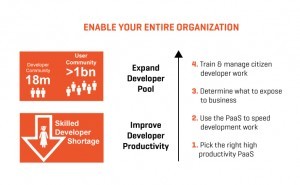
Enable your entire business with an app dev strategy
- Existing web application developers and mobile app developers are more productive
- The current pool of developers is expanded
Map your app dev strategy using our 9 Essentials Checklist
I’ve detailed nine considerations for building the mobile- and web-enabled applications your users and customers are looking for in a new whitepaper. 9 Essentials to Create Amazing Applications Faster details the key factors we feel are critically important in designing, developing, managing and deploying next-generation business applications. Download it now and get started mapping out your rapid application development strategy. And contact me on Twitter, or in the comments, with any questions or thoughts.