Hackathon Success Story: How One OpenEdge Architect Used AI to Bring Agentic Workflows to Enterprise Applications
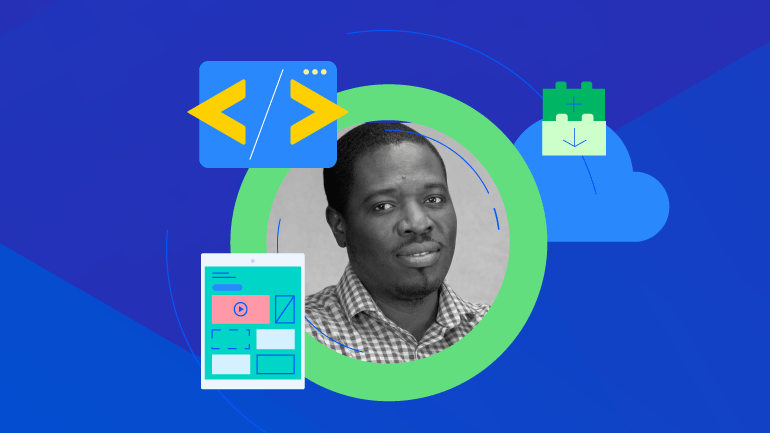
The OpenEdge × AI Innovation Challenge invited developers, partners and independent teams from around the world to explore how artificial intelligence can solve real business problems using Progress OpenEdge as the operational and data backbone. Participants were challenged to move beyond experimentation by building AI-powered solutions that demonstrated real business value and production-ready thinking.
Kenneth Chamisa, Lead Solution Architect at MIP Holdings in South Africa, earned first place by doing exactly that. Rather than building another chatbot, Kenneth developed a solution that uses AI agents to automate complex business workflows while keeping OpenEdge at the center of every decision.
Looking Beyond Chatbots
Kenneth has worked with OpenEdge since beginning his development career in 2004 and has spent the past 18 years at MIP Holdings designing enterprise software solutions. When the hackathon began, he wanted to answer a question many OpenEdge customers are asking today. How can existing OpenEdge applications participate in the rapidly evolving world of AI?
"There is still a lot of hype around AI," Kenneth said. "We wanted to look beyond just chatting with data. We've got OpenEdge, we've got the data, we are the system of record. How can we make use of that and participate in this AI journey?"
That question became the foundation of his winning project.
Building AI Around Trusted Business Data
Instead of relying on AI to make decisions independently, Kenneth's solution demonstrates how multiple specialized AI agents can work together while remaining grounded in trusted business data stored in OpenEdge.
Using OpenEdge and the Model Context Protocol (MCP), the project exposes business logic and enterprise data to AI agents responsible for different tasks. One agent might analyze sales information, another evaluate customer complaints, while others collaborate to support more complex business decisions.
The key difference is that these agents are not operating on disconnected or generic information. "The actual decision making is based on the OpenEdge platform itself," Kenneth explained.
By keeping OpenEdge as the source of business rules and operational data, AI-generated recommendations remain connected to the organization's existing processes rather than relying solely on large language models.
From Hackathon Demo to Real-World Insurance Workflows
Although Kenneth demonstrated the concept using the Sports2000 sample database, the project was inspired by real challenges MIP is addressing in the insurance industry.
One example involves claims processing. Rather than having a single AI model make every decision, multiple specialized agents can evaluate different aspects of a claim. One agent analyzes potential fraud, another assesses risk, while another reviews medical information before collectively determining whether a claim can be approved automatically or escalated to a human reviewer.
The same architectural approach can also support customer service and billing operations. In one scenario, contact center employees can ask questions in natural language instead of manually searching through numerous application screens to understand customer policies and transaction histories. In another, AI agents can monitor payment patterns and recommend collection strategies based on changing customer behavior.
Because these workflows are grounded in OpenEdge data, organizations can maintain greater confidence in the results. "There's no hallucination because it's based on the actual data," Kenneth said.
Turning Innovation Into Customer Value
The project quickly evolved beyond a hackathon submission. After returning to MIP, Kenneth shared the concepts with his colleagues and began exploring how they could be incorporated into customer solutions. Around the same time, customers were asking how AI could fit into their existing OpenEdge environments.
Instead of responding with theoretical possibilities, Kenneth was able to demonstrate a working approach. "It was quite easy to take those concepts and start implementing them," he said. "For us at the moment, it's just, what are the use cases? Where does this fit in?"
That practical experience has already helped MIP begin piloting AI-enabled workflows with customers while reinforcing that OpenEdge applications can remain central to future AI initiatives.
Why It Matters
Kenneth's project demonstrates that organizations do not need to replace their OpenEdge applications to take advantage of modern AI. By keeping OpenEdge as the trusted foundation for business data, rules and decision making, organizations can introduce AI agents that automate complex workflows while maintaining visibility into how recommendations are generated. Rather than moving enterprise knowledge outside existing systems, AI can work alongside the applications businesses already rely on every day.
Reflecting on the experience, Kenneth said the hackathon reinforced something he’s believed throughout his career. While newer languages often dominate conversations around AI development, OpenEdge and ABL are perfectly capable of supporting modern enterprise applications. As he put it, "I have no doubt in my mind that if one is using OpenEdge as a platform, you are not disadvantaged. You're not behind."
Discover What's Possible with Progress OpenEdge
The OpenEdge × AI Innovation Challenge showcased how developers are using OpenEdge alongside modern AI technologies to solve real business problems. Learn more about Progress OpenEdge, the OpenEdge AI Assistant and the OpenEdge MCP Server to discover how you can bring AI capabilities to your own OpenEdge applications.