AI Ethics and Governance - A Practical Guide

Artificial intelligence is becoming part of everyday decision-making, from enterprise analytics and customer service to healthcare, public administration, research and sustainability initiatives. As AI adoption grows, organizations need more than powerful models. They need AI systems that are trusted, explainable, accountable and aligned with human values.
That is where AI ethics and governance come in.
In plain language, AI ethics is about what responsible AI should look like. It asks whether an AI system is fair, transparent, safe, privacy-aware and aligned with the people and communities affected by it. AI governance is about how organizations make those principles real. It turns values into policies, controls, responsibilities, workflows, approvals, monitoring and evidence.
The two are closely related, but they are not identical. Ethics asks, “What should we do?” Governance asks, “How do we make sure it happens?”
This distinction matters because AI is increasingly being discussed not only as a business technology, but also as a tool for the public good. The United Nations’ Sustainable Development Goals describe the 17 SDGs as an “urgent call for action” across areas such as health, education, equality, climate and strong institutions. AI can support that agenda, but only if organizations deploy it responsibly, inclusively and with proper oversight.
The same idea sits behind AI for Good, an International Telecommunication Union initiative that describes its mission as unlocking AI’s potential to serve humanity through skills, standards and partnerships. AI for Good was established by ITU, the UN agency for digital technologies, and works with UN partners to identify practical applications of AI that can advance the SDGs.
For organizations, this creates a practical challenge: how do you move from principles to production? How do you build AI that is innovative, but also governed, auditable and safe to use in real operations?
This guide is for leaders, practitioners, policy teams, researchers, compliance teams, risk and legal stakeholders, and public-sector or institutional decision-makers who need a practical understanding of AI ethics and governance.
What Is AI Ethics and Governance?
AI ethics definition
AI ethics refers to the values, principles and responsibilities that guide how artificial intelligence should be designed, deployed and used.
It asks whether an AI system is doing the right thing for the people, organizations and communities affected by it. It considers not only whether a system works, but whether it works fairly, safely and transparently.
Common AI ethics themes include fairness, accountability, transparency, privacy, safety, human oversight and contestability. These themes appear across major global frameworks. For example, UNESCO’s Recommendation on the Ethics of Artificial Intelligence identifies human rights and dignity as the cornerstone of ethical AI and highlights principles such as transparency, fairness and human oversight.
In practice, AI ethics is not just a philosophical discipline. It is a decision-making lens. It helps organizations ask better questions before AI systems are deployed, scaled or connected to sensitive workflows.
AI governance definition
AI governance is the set of structures, policies, processes and accountability mechanisms used to manage AI systems throughout their lifecycle.
Governance covers the operational side of responsible AI. It defines how AI use cases are approved, how risks are assessed, how data is sourced, how models are tested, how systems are monitored, how incidents are handled and how decisions are documented.
A mature AI governance approach typically includes acceptable-use policies, risk classification, data governance, model documentation, testing standards, human oversight requirements, monitoring, incident response, audit trails and vendor governance.
The NIST AI Risk Management Framework is a useful reference because it helps organizations manage risks to individuals, organizations and society associated with AI. Its core functions are Govern, Map, Measure and Manage.
Ethics vs. governance - what’s the difference?
The simplest way to understand the relationship is that ethics sets the direction, while governance makes that direction repeatable in real systems.
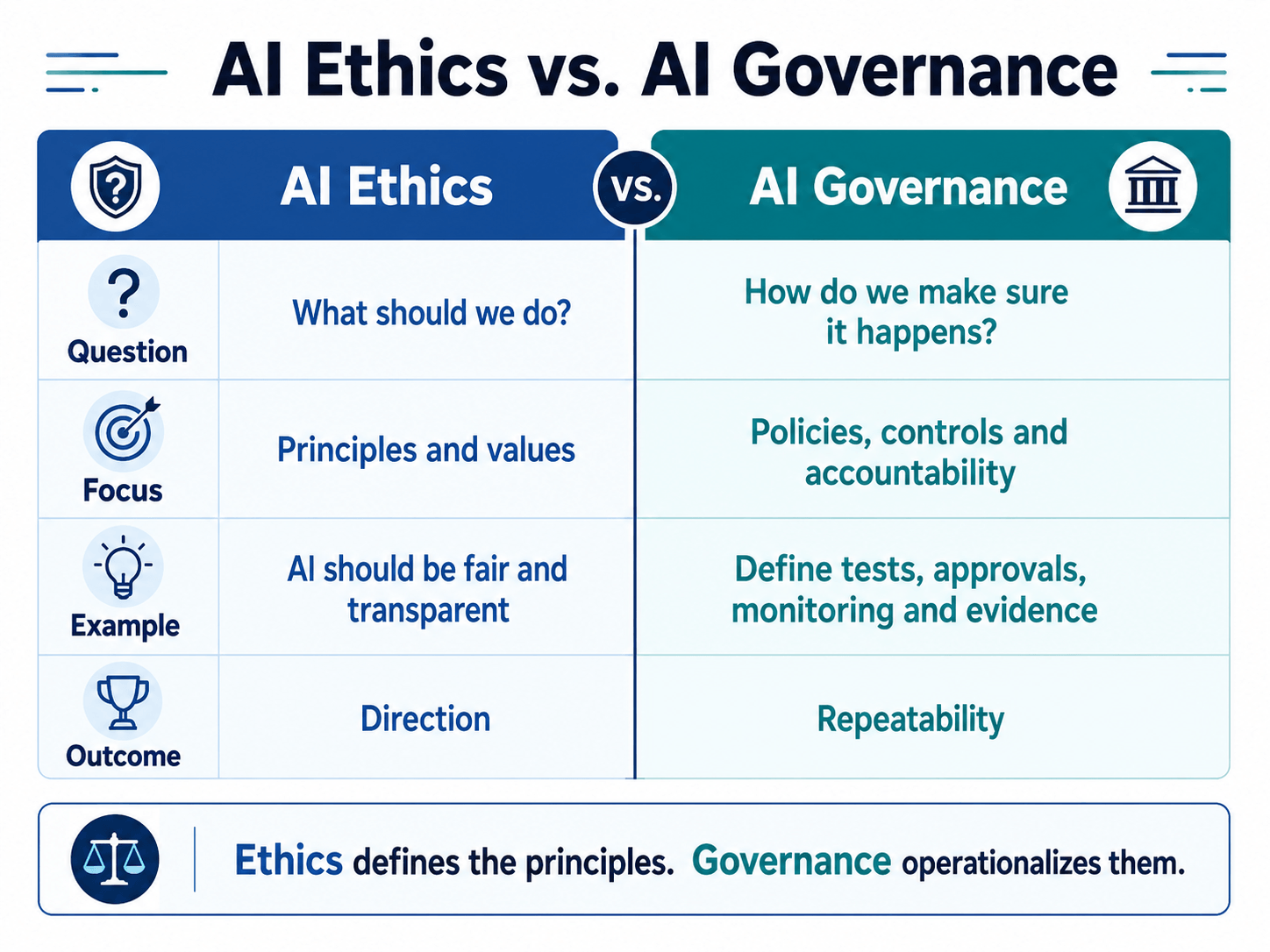
AI ethics defines responsible principles; AI governance turns those principles into policies, controls, workflows and evidence.
Why Are AI Ethics and Governance Important?
Growing adoption and rising risk
AI is now being used in knowledge discovery, customer service, software development, legal research, clinical workflows, fraud detection, benefits administration, compliance operations and decision support.
As adoption grows, so does the potential impact of AI errors, bias, misuse and unexplainable outcomes. The risk increases when AI systems are used in critical decisions, sensitive contexts or workflows that affect people’s rights, safety, access to services or economic opportunity.
This is why AI governance has become a business, regulatory and public-interest priority. The EU’s AI Act, for example, sets out risk-based rules for AI developers and deployers, with a focus on safety, fundamental rights and human-centric AI.
AI, the SDGs and public good
AI ethics and governance are also important because AI is increasingly connected to sustainable development.
The UN notes that AI can support SDG progress through applications such as diagnostics and predictive analytics in healthcare, crop monitoring and climate-related use cases. But that potential does not remove the need for safeguards. In fact, the more consequential the use case, the stronger the governance requirement.
The UN Global Compact has also encouraged companies to align AI use with the SDGs and embed ethical considerations into AI lifecycle management. Its guidance highlights the need for governance rooted in transparency, accountability and human-centric design.
For enterprise teams, this creates a useful framing: AI governance is not only about avoiding harm. It is also about making AI useful, trustworthy and scalable enough to support meaningful outcomes.
Key risks organizations must manage
AI governance helps organizations manage risks such as:
- Bias and unfair outcomes. AI systems can reproduce or amplify existing inequalities if training data, business rules or deployment contexts are poorly understood.
- Lack of transparency. Users may not know when AI is being used, what data it is drawing from or why it produced a particular output.
- Privacy and data misuse. AI systems can expose, infer or misuse sensitive information if data controls are weak.
- Safety, reliability and performance failures. AI systems may perform well in tests but fail when exposed to changing real-world conditions, edge cases or new data.
- Weak accountability. Responsibility can become fragmented across data teams, model providers, application owners, vendors and business users.
- Misuse or unintended consequences. AI tools designed for one purpose can be used in ways that were never assessed or approved.
Principles of Responsible AI
The major responsible AI principles are explored in more detail below.
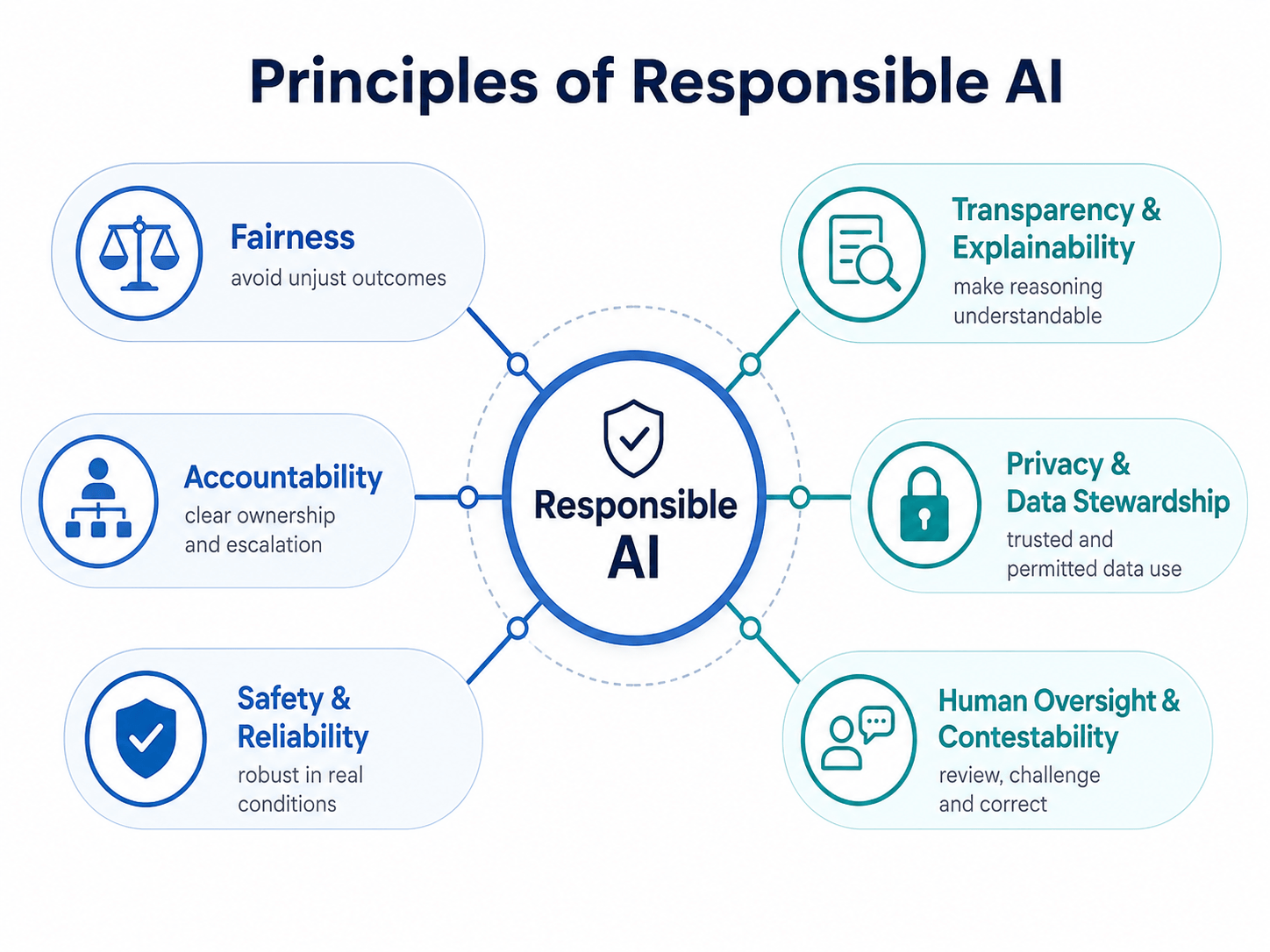
Responsible AI principles work together: fairness, transparency, accountability, privacy, reliability and human oversight all need to be governed as part of the same system.
The Components of an AI Governance Framework
An AI governance framework should be practical enough to guide day-to-day decisions and strong enough to support audit, compliance and accountability.
| Component | Purpose | Key owner | Example control |
| Policies and standards | Define acceptable AI use and development expectations | Legal, compliance, AI leadership | Acceptable-use policy and deployment standard |
| Roles and accountability | Clarify ownership, approvals and escalation paths | Executive sponsor, AI governance lead | Named system owner and AI review board |
| Risk assessment and classification | Match controls to use-case risk | Risk, compliance, product owner | High-risk use-case review threshold |
| Data governance | Ensure AI uses appropriate, authorized and trusted data | Data governance, security, business owner | Access controls, provenance and data-quality checks |
| Model and system validation | Test performance, fairness, safety and reliability | Data science, engineering, risk | Pre-deployment validation and bias testing |
| Lifecycle controls | Govern AI from design through retirement | Product, engineering, governance team | Stage-gate approvals and change management |
| Monitoring and incident response | Detect failures, drift, harm and policy breaches | Operations, security, compliance | Incident playbook and remediation workflow |
| Documentation and auditability | Create evidence for review, compliance and improvement | System owner, compliance, engineering | Decision logs, model cards and approval records |
How to Operationalize AI Ethics in Practice
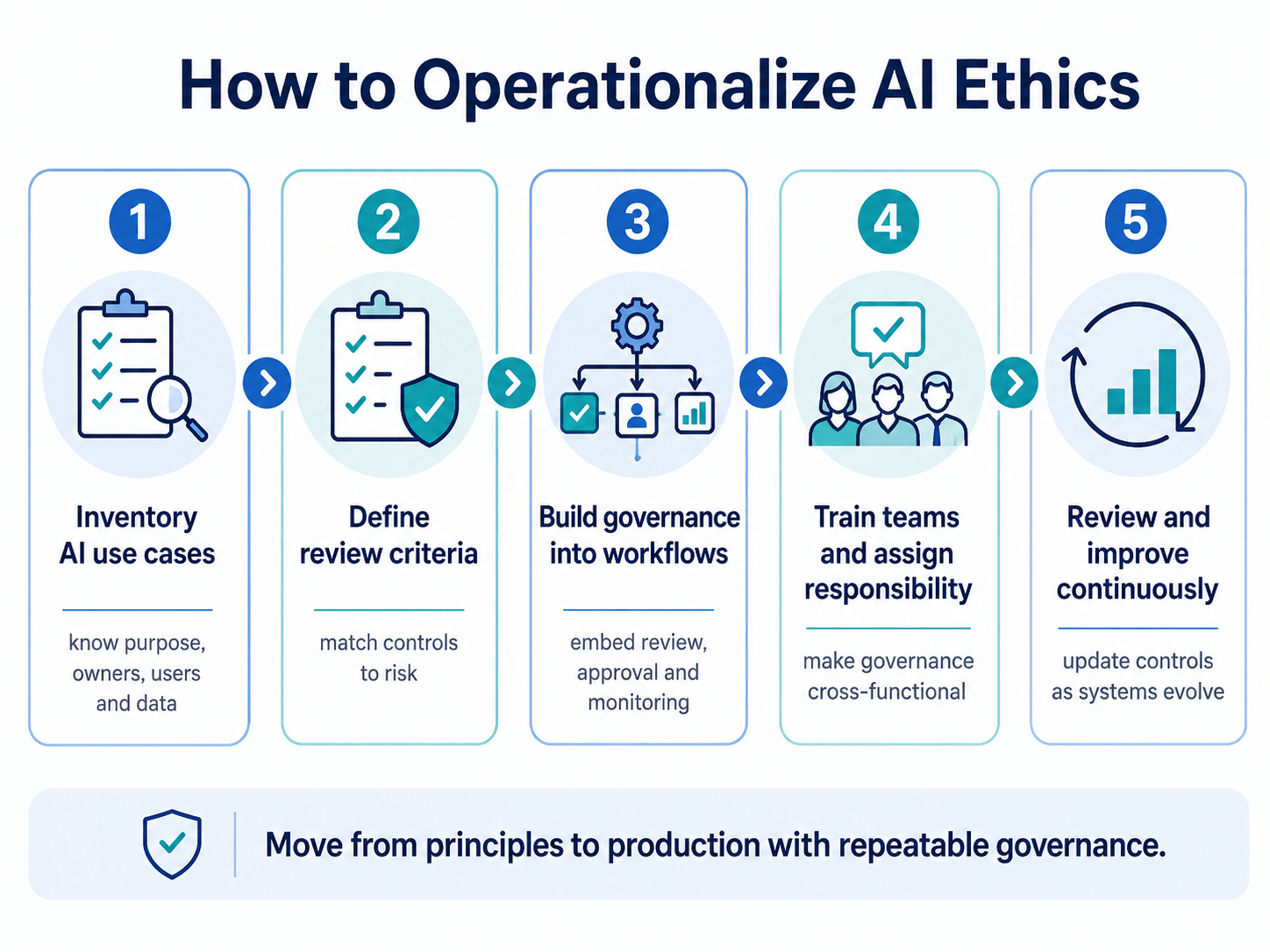
A practical five-step path from responsible AI principles to governed production use.
Operationalizing AI ethics means moving from principles to repeatable controls. Teams need visibility into AI use cases, review criteria matched to risk, governance built into workflows, clear ownership and a process for continuous improvement.
For Progress, this connects directly to the need for governed AI workflows. Progress Data Platform helps organizations limit AI outputs to governed enterprise data using retrieval-augmented generation, semantic context and access controls.
Train teams and assign responsibility
AI ethics is cross-functional. It cannot sit only with data science, legal or compliance.
Business teams need to understand appropriate use. Technical teams need to understand policy requirements. Risk teams need enough technical literacy to ask the right questions. Leaders need to understand where accountability sits.
Training should focus on practical scenarios, not abstract principles alone.
Review and improve continuously
AI governance should evolve as models, data, regulations, business processes and risks change.
A practical governance model should include periodic reviews, incident retrospectives, policy updates, control testing and feedback loops from users and auditors.
AI Ethics and Governance Across Sectors
Healthcare
Healthcare AI creates significant opportunity, but it also raises high-stakes ethical and governance questions. AI may support diagnosis, treatment planning, clinical research, drug development, patient engagement or public health surveillance.
The World Health Organization’s guidance on ethics and governance of AI for health identifies ethical challenges and risks in health AI and sets out principles intended to make sure AI works for the public benefit.
In healthcare, governance needs to address safety, clinical validation, bias, patient privacy, explainability, liability and human oversight.
Public sector
Public-sector AI affects public trust, rights, transparency and legitimacy. AI may be used in citizen services, fraud detection, case management, resource allocation, policing, education or benefits administration.
Governance in this context must be especially clear about accountability, contestability and evidence. Citizens should not be subject to consequential AI-supported decisions that cannot be explained, reviewed or challenged.
This is also where the UN SDG lens matters. Public-sector AI can support goals such as good health, quality education, climate action and strong institutions, but only when systems are inclusive, transparent and governed.
Enterprise and commercial use
In enterprise settings, AI governance protects brand trust, operational reliability, compliance and decision quality.
Organizations using AI for customer service, employee productivity, analytics, legal support, product development or knowledge discovery need to govern not only the model, but the data and workflow around it.
Standalone AI models generate outputs based on patterns and probabilities. Enterprise AI needs to work from trusted, permitted and contextual business information. Progress Data Platform for AI supports this by using semantic RAG to generate AI outputs from authoritative enterprise data sources only, helping reduce hallucinations and unverifiable responses.
Trade-offs
Innovation vs. control
Governance is sometimes treated as a barrier to innovation. In reality, the absence of governance often prevents innovation from scaling.
Teams can experiment quickly with AI, but organizations cannot confidently deploy AI into sensitive workflows without controls. The right governance model should enable speed by making expectations clear.
Transparency vs. model complexity
Some AI systems are difficult to explain in simple terms. That does not remove the need for transparency.
Organizations may not always be able to explain every internal model parameter, but they can explain the system’s purpose, data sources, limitations, evaluation results, controls, outputs and escalation routes.
Global principles vs. local implementation
AI principles are often global. Implementation is local.
Fairness, accountability and transparency may be widely accepted, but the way they are applied depends on regulation, sector, culture, risk tolerance, data availability and organizational maturity.
Policy ambition vs. operational reality
It is easy to write a responsible AI policy. It is harder to make that policy work across real systems, real teams and real deadlines.
Operational governance requires tooling, ownership, training, architecture, documentation and continuous review. Without that operational layer, AI ethics remains a set of intentions rather than a repeatable business discipline.
Key Takeaways
AI ethics and governance are connected, but they play different roles. Ethics sets the principles. Governance turns those principles into practice.
Ethics asks whether AI is fair, transparent, safe and accountable. Governance defines who is responsible, what controls are required, how risks are assessed, how decisions are documented and how systems are monitored over time.
The UN SDGs and AI for Good movement make this conversation broader than compliance alone. AI can help address major global challenges, but only when it is designed and governed responsibly. The same is true inside the enterprise. AI can improve research, decisions, service delivery and productivity, but only when it is grounded in trusted data and controlled by clear governance.
That is why the next phase of enterprise AI will be defined less by who has the most impressive model and more by who can build AI that is governed, explainable and defensible.
Progress Data Platform helps organizations move toward that goal by providing a governed data foundation for trusted AI and analytics. It helps teams unify enterprise data, apply semantic context, enforce access controls and support AI systems that produce more accurate, explainable and reliable outcomes.
Frequently Asked Questions
What is the difference between AI ethics and AI governance?
AI ethics defines the values and principles that should guide responsible AI use, such as fairness, transparency, privacy, safety and accountability. AI governance turns those principles into policies, controls, workflows, oversight and evidence.
What are the main principles of ethical AI?
Common principles include fairness, transparency, explainability, accountability, privacy, safety, robustness, human oversight and contestability.
What should an AI governance framework include?
An AI governance framework should include policies, standards, roles, risk classification, lifecycle controls, data governance, model validation, monitoring, incident response, documentation and auditability.
Who owns AI governance in an organization?
AI governance should have executive ownership, but it is cross-functional in practice. Legal, risk, compliance, security, data, product, engineering and business teams all play a role.
How do you assess AI risk?
AI risk can be assessed by looking at the system’s purpose, affected stakeholders, data sensitivity, level of autonomy, explainability needs, potential harm, regulatory exposure, security implications and whether the system influences important decisions.
Why is human oversight important?
Human oversight helps prevent overreliance on AI and creates a route for review, escalation and correction. It is especially important when AI systems affect rights, safety, access to services, regulated decisions or high-impact business outcomes.
How does AI governance support the UN Sustainable Development Goals?
AI governance helps organizations use AI in ways that are aligned with sustainable development, human rights and public trust. It supports SDG-aligned AI by helping ensure systems are fair, inclusive, explainable, privacy-aware and accountable.
Build AI governance into the foundation of your enterprise AI strategy.
Explore how Progress Data Platform helps organizations unify, govern and activate trusted data for accurate, explainable AI outcomes.