
Introduction to Object-oriented Programming: OpenEdge 12 Course
On-Demand Training

Course Description
This course introduces the object-oriented programming (OOP) capabilities of Progress OpenEdge ABL. You learn to define and use ABL classes to model real-world business entities and application behavior. You explore the structure and anatomy of classes and understand how access modes control visibility and encapsulation.
As the course progresses, you work with more advanced object-oriented features such as, inheritance, interfaces, abstract classes, enums, delegation, static members, and events. You learn how to design class hierarchies, override methods and properties, apply polymorphism, and use delegation to promote flexibility and reuse.
This course is available as part of the Basic OpenEdge Developer Learning Path and Certification Exam program. Please log in to the Progress Education Community with your Progress ID, navigate to the Content Library and search for the Basic OpenEdge Developer Learning Path and Certification Exam. Then simply click the title for FREE access to all the content (courses, assessment exams, and certification exam).
Audience
This course is for experienced Progress OpenEdge Advanced Business Language (ABL) developers who want to learn how to use the object-oriented capabilities of ABL.
Duration
Equivalent to 8 hours of learning
Product Version
This course is compatible with OpenEdge 12.2 and 12.8.
What you will learn
After taking this course, you should be able to:
Determine and apply the core principles of object-oriented programming—including abstraction, encapsulation, inheritance, polymorphism, and delegation.
Design and define well-structured ABL classes by creating data members, properties, constructors, methods, destructors, and events with appropriate access modes.
Create, manage, and test class instances by controlling object lifecycles, accessing members safely, and validating behavior through test procedures.
Implement inheritance and polymorphism by defining class hierarchies, overriding methods and properties correctly, and enforcing object hierarchy through constructors.
Improve application design by using interfaces, abstract classes, and enums to define contracts, templates, and strongly-typed constants.
Apply delegation and composition to share responsibilities between objects while reducing coupling and improving flexibility.
Define and use static members and static constructors to manage class-level or session-wide data and behavior.
Implement event-driven programming by defining, publishing, subscribing to, and handling class events.
Prerequisites
You should already be able to:
Knowledge of the core components and architecture of the Progress OpenEdge platform
Knowledge of the Developer Studio interface and its key perspectives
Ability to create and configure an OpenEdge database
Knowledge of procedural coding concepts and syntax in ABL
How to Subscribe
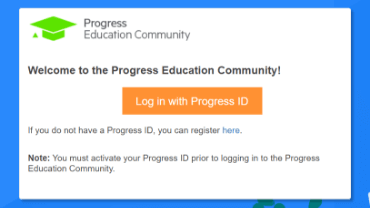
Step 1 - Log in
Visit the Progress Education Community (PEC) and log in with your Progress ID. If you do not have a Progress ID, you can register here.
Note: You must activate your Progress ID prior to logging in to the Progress Education Community
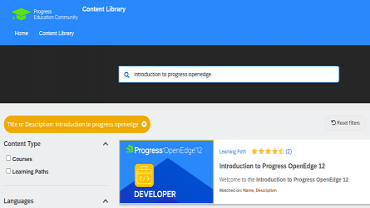
Step 2 - Find Your Content & Start Learning
Navigate to the Content Library and search for: Basic OpenEdge Developer Learning Path and Certification Exam. Then simply click the title for FREE access to the course.

Interested in the Class?
Stay up to date with technology trends and get the most out of your Progress technology investment.