
Tracking strategies
Overview
Not all audiences are the same, and visitors in different cohorts exhibit different behavior. You can configure how the tracking cookie in Sitefinity CMS behaves when your visitors provide an email, thus becoming known contacts, and log out, becoming anonymous visitors again.
You configure this behavior to improve the mapping between your visitors and contacts, and how actions are attributed to the corresponding contact journey.
NOTE: This article explains the behavior when people use the same user agent (browser). For example, when a physical person uses multiple accounts or multiple people share the same browser.
The article does not explain the behavior when you import data or when the same physical person uses multiple devices or browsers to visit your website.
When different browsers are used, Sitefinity Insight maps distinct visitors only when they are contacts using their e-mail addresses. Usually, visitors provide their e-mails when they log in or submit a form response on your site.
Sitefinity Insight visitors, contacts, properties, and subject mapping
Sitefinity Insight identifies the site visitors by UniqueId (internally known as Subject) and Data source. Normally, when two distinct visitors, identified by distinct pairs of UniqueId and Data source, provide the same email address, they are merged into a single contact.
Sitefinity Insight selects the contact properties (such as FirstName, LastName, or Email) based on the UniqueId + Data source combination. If this specific combination already exists and you upload a new value for a property, the existing property value will be overwritten.
If you upload a UniqueId + Datasource combination that does not exist in Sitefinity Insight, but the Email matches an existing contact in Insight, those two contacts will be merged. While contact property values are updated, you can also see all different metadata values on the contact details page.
For more information, see SubjectMapping.
Configurable options in Sitefinity CMS
Sitefinity Insight Connector for Sitefinity CMS offers the following options for mapping the site visitor’s actions to the respective contacts and their journeys:
- Tracking cookie handling on login
- Persist
Sitefinity CMS preserves an existing tracking cookie when a site visitor logs in and out. - Renew
Sitefinity CMS generates a new cookie every time a site visitor logs in, even if the same site visitor logs in multiple times. - RenewOnlyForNewUserLogin
Sitefinity CMS generates a new tracking cookie only when different site visitors log in. If the same site visitor logs in multiple times, the existing tracking cookie is reused.
- Persist
- Remove cookie on logout
- If set to true, Sitefinity CMS deletes the tracking cookie when the site visitor logs out.
- If set to false, Sitefinity CMS preserves the tracking cookie after the site visitor logs out.
NOTE: The default mode of this setting is changed to True starting with Sitefinity CMS 15.4.
The following diagram visualizes how Sitefinity Insight attributes the site visitor’s actions to contact journeys, depending on how you have configured the Sitefinity Insight Connector. Each scenario is described in detail below.
NOTE: Contact journey calculations occur after the site visitor has performed some actions. Sitefinity Insight works retrospectively using all visitor actions stored in the data center, thus, it can attribute anonymous actions to the respective contact journeys.
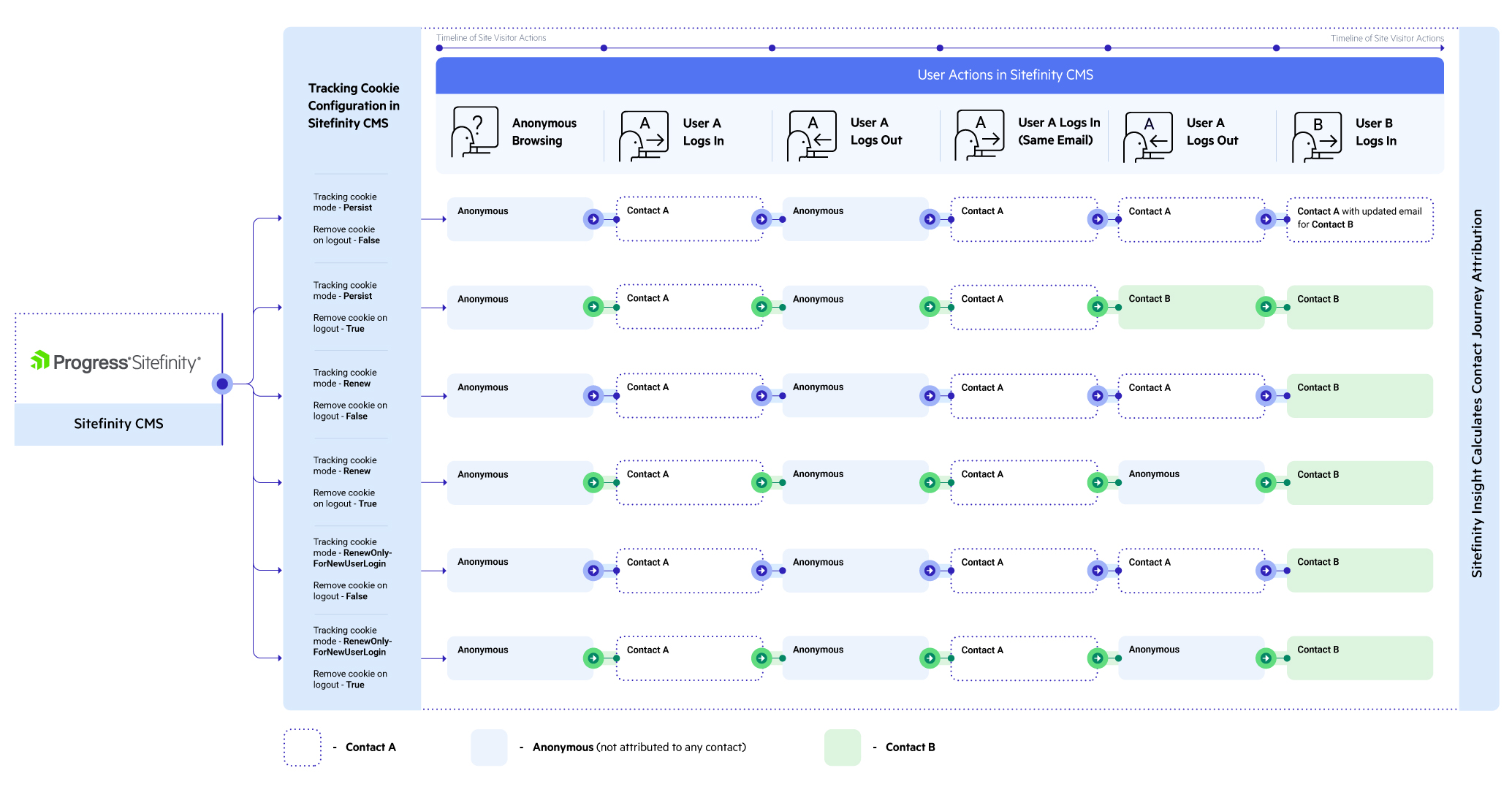 The following sections provide a detailed description of the configuration options and how they interact.
Persist mode combined with keeping the tracking cookie on logout
In this mode, Sitefinity CMS creates a new cookie if it does not already exist. After that, the same cookie is reused regardless of the site visitor's actions. When the site visitor provides an email and becomes a known contact, the actions they performed while browsing anonymously are attributed to their contact journey. If the site visitor provides a second email, Sitefinity Insight updates the contact metadata with the second email. The tracking cookie remains in use if a contact logs out and continues browsing anonymously.
The result is that all visitor actions, performed anonymously or as a known contact, are attributed to a single contact journey, and the contact’s email address is updated if it changes.

Persist mode combined with removing the tracking cookie on logout
RECOMMENDATION: We recommend using this mode, unless your business case or audience has very specific behavior. This mode is the most straightforward and gives you the full picture of a contact journey, including actions performed while accessing your site anonymously.
In this mode, Sitefinity CMS creates a new cookie if one does not already exist. The cookie is deleted when the contact logs out, and a new cookie is created the next time the site visitor performs an action.
The result is that all actions performed anonymously are attributed to the contact journey of the last contact who provided their e-mail address. If the physical person accessing your site becomes a contact with a second email, the anonymous actions and the actions performed as a contact are attributed to a separate contact journey.

Renew mode combined with keeping the tracking cookie on logout
In this mode, Sitefinity CMS creates a new cookie when a site visitor provides an email and becomes a contact. The tracking cookie remains in use if a contact logs out and continues browsing anonymously.
As a result, all anonymous visitor actions performed before the first contact becomes known are reported but not attributed to any contact journey. After that, all actions performed before the physical user provides a second email are attributed to the same contact journey, whether performed anonymously or as a contact. If a physical user provides a second e-mail, a separate contact is created, and the actions performed are attributed to a second contact journey.

Renew mode combined with removing the tracking cookie on logout
In this mode, Sitefinity CMS creates a new cookie when a site visitor provides an email and becomes a contact. The tracking cookie is removed when the physical user logs out, and a new cookie is regenerated the next time the same visitor provides an email on your site.
As a result, all actions performed while the visitor browses anonymously are not attributed to any contact journey. Only after the physical user provides their email and becomes a contact, their actions are attributed to the respective contact journey.

RenewOnlyForNewUserLogin mode combined with keeping the tracking cookie on logout
In this mode, Sitefinity CMS creates a new tracking cookie if one does not already exist and when the site visitor provides a different email than the one already used for a previous contact. To achieve this behavior, Sitefinity CMS keeps the last known email in a separate session cookie, thus, the contact identity is bound to both the user agent and the session together.
The tracking cookie remains in use if a contact logs out and continues browsing anonymously.
As a result, all actions performed anonymously or as a contact are attributed to a single contact journey until the physical user provides another email. When the physical user does so, their subsequent actions are attributed to a second contact journey.

RenewOnlyForNewUserLogin mode combined with removing the tracking cookie on logout
In this mode, Sitefinity CMS creates a new cookie if one does not already exist and when the site visitor provides a different email than the one already used for a previous contact.
The tracking cookie is removed when the physical user logs out. Thus, a new cookie is regenerated the next time the visitor performs an action on your site.
As a result, the actions of the physical user are attributed to the respective contact journey to the respective contact, with the single specific case when the users logs out, browses anonymously and then logs in with a different email. In this case, their actions performed anonymously are lost and not attributed to any contact journey.

Configure a strategy
To set up the desired cookie handling strategy, perform the following:
- Log in to your Sitefinity CMS backend as an administrator.
- Navigate to Administration » Settings » Advanced.
- In the tree on the left, click DigitalExperienceCloudConnector.
- In the Tracking cookie handling on login dropdown, select the strategy.
- Optionally, toggle Remove tracking cookie on logout checkbox.
- Click Save changes to confirm your choice.