Agentic AI vs. Traditional Automation: What Changes in CMS?
Businesses are moving toward agentic AI systems that learn, adapt and deliver results continuously. Are you ready to evolve your CMS from a publishing tool into a growth engine?
For years, business leaders and digital teams asked a simple question: How can we publish faster?
That question shaped the way CMS automation evolved. Rule-based workflows like scheduled posts, tagging and approval chains gave organizations efficiency. But that efficiency alone is no longer enough.
Today, the question has changed as marketers, developers and executives ask: How can our CMS learn, adapt and personalize content in real time to drive growth?
The limits of traditional automation make that impossible, so forward-looking organizations are already exploring the next stage: Agentic AI. Interestingly, more than 72% of business leaders have begun adopting it across their operations, seeing it as a pathway to higher efficiency, personalization and growth.
This article is for you if you’re ready to see how this shift could transform your workflows. It will guide you through the new era, where CMS automation moves from static rules to self-improving AI agents that unlock dynamic workflows, real-time personalization and measurable business value.
Agentic AI, The New Era of Automation
Meeting today’s customer expectations requires more than efficiency. People want personalized experiences and exceptional service at scale, which static, rule-based automation cannot deliver.
As a result, businesses need an approach that supports them in meeting these customers’ needs. This is where Agentic AI comes in, and it fills the gap with four defining traits that make automation intelligent:
- Proactive: Initiates actions without waiting for prompts
- Goal-driven: Works toward outcomes, not just tasks
- Autonomous: Executes with minimal oversight
- Adaptive: Learns and improves continuously
Together, these traits give agentic AI the ability to sense context, reason and act as a partner in business innovation.
But what is agentic AI?
McKinsey describes AI agents as tools that can interact with their environment, automate complex tasks and perform work that once required humans. Think of them as a coordinated team of specialists, each playing a role to achieve a shared outcome.
For example, consider a typical content workflow where marketers/SEOs research keywords, writers draft articles, editors review and the writer or editor schedules content in the CMS.
With agentic AI, a “manager” agent could oversee specialized agents for keyword research, writing, editing and publishing, running the entire process smoothly inside your CMS.
The diagram below details how agents can carry out their functions.
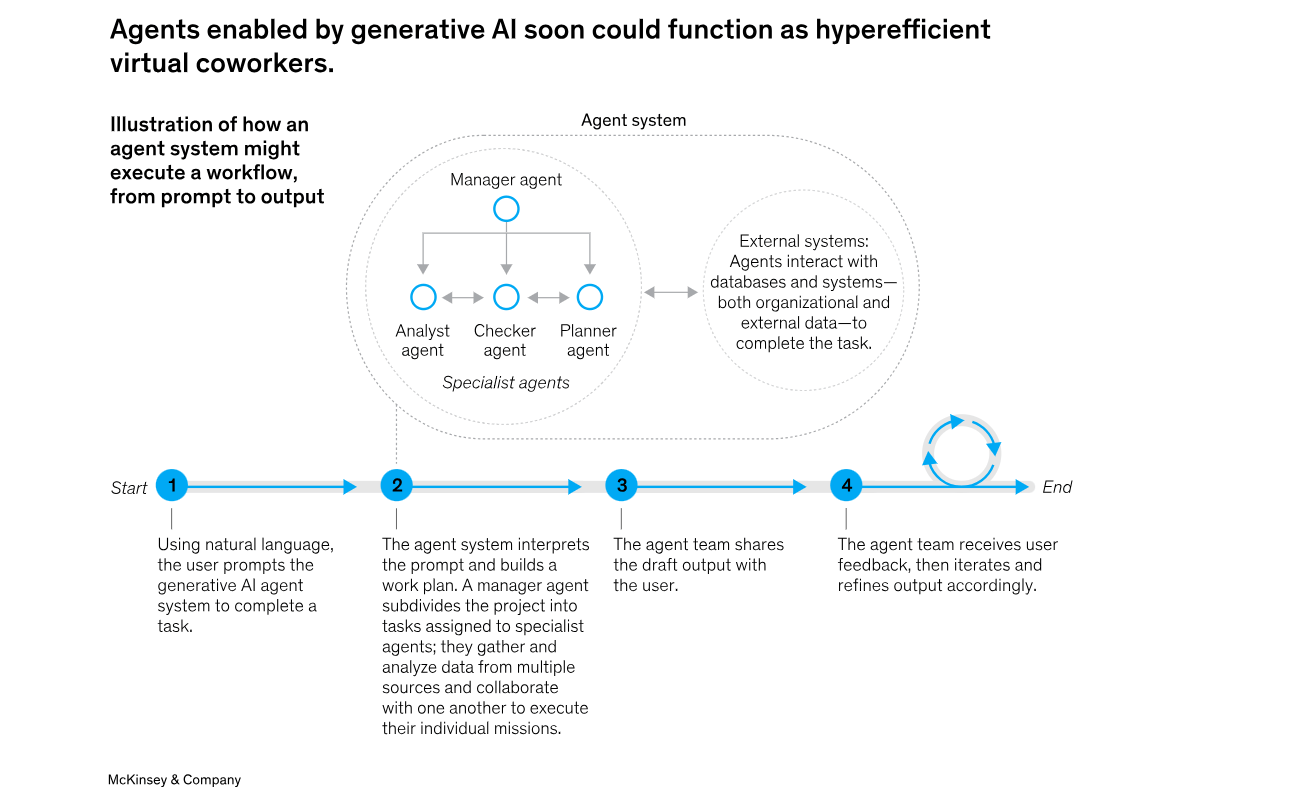
Source: McKinsey
The potential impact is significant. Research shows that 66% of companies using agentic AI report increased productivity, while 54% report an improved customer experience. These numbers highlight how intelligent automation ties directly to growth and competitiveness.
Let’s take a pause here for a moment.
If agentic AI is setting the new standard for automation, the real question becomes: How does this power transform CMS workflows? That’s what we’ll explore next.
Traditional Automation vs. Agentic AI: Side-by-Side
You’ve seen how Agentic AI introduces a new way of thinking about automation.
To put the difference into perspective, here’s a side-by-side view of how traditional automation compares with agentic AI.
| Aspects | Traditional Automation | Agentic AI |
|---|---|---|
| Definition | Executes tasks based on rules and direct instructions | Acts with initiative, plans ahead and learns while executing tasks |
| Scope of intelligence | Narrow and task-specific | Broad, goal-oriented and adaptive |
| Autonomy | Low, dependent on fixed input | High, capable of independent decision-making in real time |
| Instruction model | Requires explicit prompts or rule sets | Understands objectives and acts toward them |
| Adaptability | Limited to predefined conditions | Continuously adjusts based on context and user feedback |
| System interaction | Operates within siloed processes | Connects across systems, tools and workflows |
| Decision-making | Rule-based and deterministic | Context-aware, strategic and multistep |
| Example | Auto-tagging or fixed publishing schedules | Dynamic scheduling based on context awareness, adaptive categorization and layout optimization |
How Agentic AI Changes CMS Workflows
The idea of an AI agent inside a CMS may sound futuristic, but the foundations are already here. Latest research, including LangChain’s findings, shows agents already performing well in content workflows, especially in research, summarization and knowledge management.
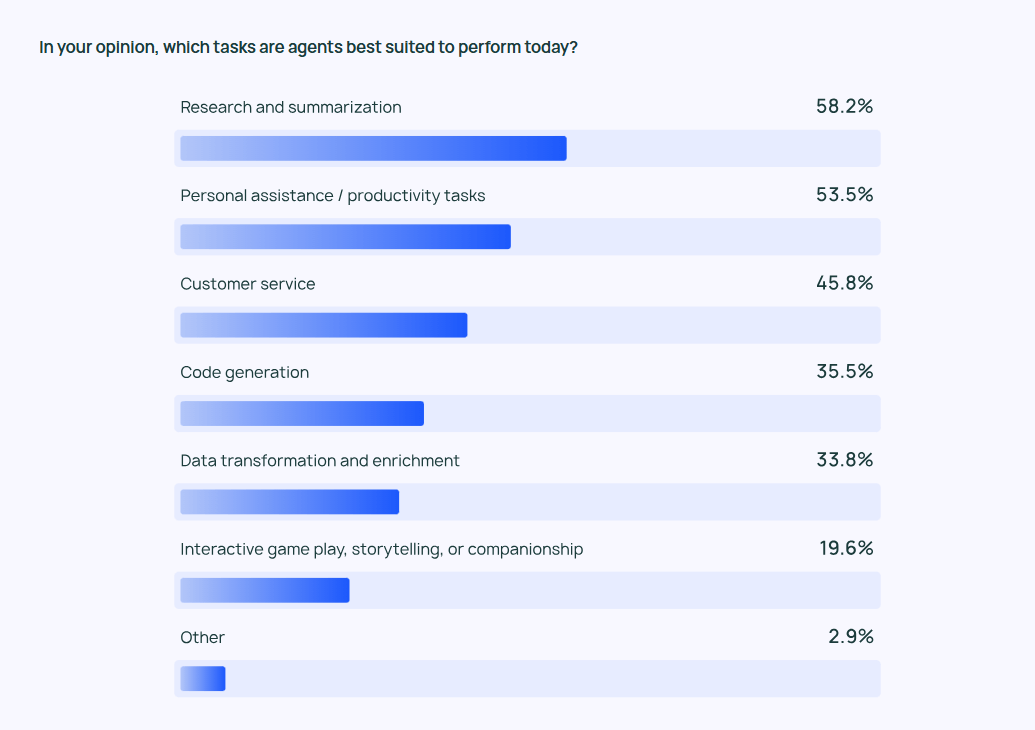
Source: LangChain
Sara Faatz, Director of Technology Community Relations at Progress Software, explained further in an interview with HostingAdvice:
“An AI agent can make context-aware decisions, adapt to real-time data and continuously learn from user interactions. Because of this, it has the ability to autonomously generate, refine and personalize high-quality content at scale.”
In practice, this means a CMS empowered by agentic AI won’t just store and publish content. It will actively participate in the content lifecycle—shaping workflows, adapting to audience behavior and continuously improving results.
So what does an AI agent in the CMS look like, and what is it changing?
1. Dynamic Workflows (Auto-Adjust Based on Results)
Traditional automation runs on static rules. In contrast, agentic AI goes further by learning from outcomes and adjusting workflows automatically.
For example, you might publish a blog post at 9 a.m., only to see engagement peak later in the day. Instead of waiting for you to reschedule, the CMS shifts future posts to the higher-performing window.
Agentic AI builds context over time, capturing editorial priorities, audience behavior and distribution strategies. This way, it functions like a proactive assistant, refining processes as it learns.
What changed?
From fixed schedules to workflows that auto-adjust in real time.
2. Real-Time Personalization
Personalization has always been the promise of digital platforms, yet in most CMSes, it still feels rigid. You set a few audience rules, maybe segment by location or behavior, and that’s it. But as the data pile up, your team is drowning in data (clicks, heatmaps, CRM records). In the long run, turning it into real action takes time and people.
That delay is costly. Customers expect instant, relevant and exceptional experiences, but engagement and revenue slip when it lingers. It’s no surprise that 77% of business leaders who prioritize offering a personalized experience saw a positive ROI.
This is where agentic AI makes the difference.
Instead of waiting on analysts or marketers to interpret the numbers, the CMS itself can use the available data to shape the experience as it happens. A visitor scrolling through your site could see content blocks shift in real time, recommendations can change on the spot and campaigns can adapt automatically to behaviors as they unfold.
What changed?
From rigid audience rules to live personalization shaped by evolving data.
3. Continuous Optimization
In a traditional CMS, teams schedule content, track performance and step in later to adjust. Even with early AI tools, systems only suggested improvements, and humans still had to act.
Agentic AI breaks that cycle. It tests variations in real time, learns what drives engagement and fine-tunes delivery automatically. Instead of waiting for a team to intervene, the CMS improves itself continuously, keeping content relevant, impactful and growth-focused.
What changed?
From after-the-fact adjustments to self-improving content in real time.
4. Intelligent Integration
Imagine your CMS actively talking to the other business tools you rely on, your CRM, marketing automation and analytics platforms, in real time. With agentic AI, the CMS pulls data and uses those insights to translate content, adjust formats and launch campaigns.
By connecting systems seamlessly, the CMS becomes the hub of digital operations. It cuts out repetitive handoffs, streamlines collaboration and drives smarter, faster decisions across the entire content lifecycle.
What changed?
From disconnected tools to a CMS that integrates and acts across systems.
5. Data-Driven Decisions
CMS platforms collect mountains of data, but much goes unused because teams still rely on manual analysis. Dashboards pile up, insights lag and the moment has passed by the time a team member jumps in to make sense of the data.
Instead of waiting for reports, your CMS applies data instantly, driving engagement and growth without extra effort from your team.
What changed?
From delayed insights to data that drives instant action.
The Business Value of Agentic AI in CMS for Your Organization
Agentic AI has enormous potential, but it’s not a silver bullet. Its success depends on how organizations use it strategically. Those who align it with real business goals will unlock its full impact.
Agentic AI is quickly moving from concept to business reality. Gartner projects that by 2029, it will autonomously resolve 80% of common customer service issues, cutting operational costs by 30%.
For organizations, the message is clear. Embedding intelligent agents into CMS workflows reduces costs, scales personalization and accelerates growth while keeping teams focused on higher-value work.
Efficiency Gains
Agentic AI automates content operations by handling repetitive CMS tasks like scheduling, categorization, campaign setup and evolving with changing needs.
Instead of waiting for teams to adjust workflows, the system adapts in real time. This leads to more efficiency gains for organizations. According to PwC’s AI Agent Survey, businesses using agentic AI have reported productivity gains of up to 66% in complex tasks, freeing staff to focus on strategy and higher-value creative work.
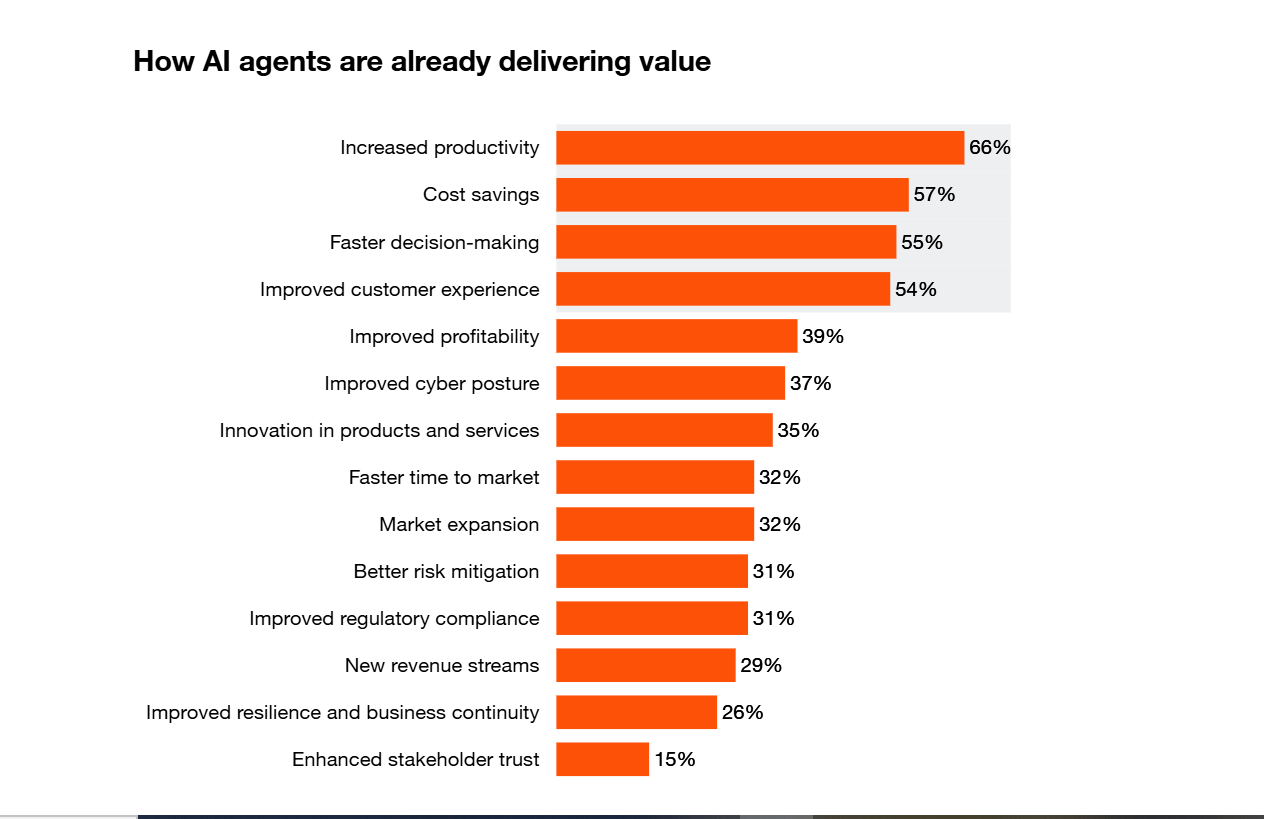
Source: PwC AI agent survey
Better Personalization
For many marketers, personalization still means translating profile data into fixed rules. Teams sift through 360-degree profiles data, analyze reports and then decide how to tailor content. It works, but it’s slow and limited.
As agentic AI continuously analyzes this data, it creates an evolving personalization layer that adapts as customers’ needs change, delivering more relevant experiences and stronger engagement without extra manual effort.
Reduced Manual Oversight
Agentic AI takes over routine reviews, approvals and adjustments, reducing the need for constant supervision. Its ability to take over content publishing, adapt it to different channels and audience needs, and optimize automatically gives teams more time to focus on strategy and growth.
Faster Adaptation to Change
Markets shift fast, technology evolves, customer behaviors change and economic swings can throw plans off course. Traditional workflows struggle here because every adjustment depends on manual effort, leaving teams scrambling and slowing growth.
Agentic AI keeps businesses ahead. It spots changing behaviors, updates campaigns instantly and aligns content with new trends in real time. The result is timely, relevant experiences that protect revenue and strengthen competitiveness.
Agentic AI clearly brings huge benefits to CMS workflows, efficiency, personalization and adaptability, but that doesn’t mean it comes without challenges. Data quality issues, integration complexity and change management can all limit results if overlooked.
That’s why careful execution is key.
In the next section, we’ll explain how to get started the right way so your team sets a strong foundation for success.
Ready to Adopt Agentic AI in Your CMS? Start Here
The promise is clear: fewer repetitive tasks, smarter workflows and personalization that evolves with data to drive growth. But like any powerful tool, the key is starting right.
Here’s how to get started, step by step:
1. Audit Your Workflows
Begin by identifying where your team spends the most time. Is it tagging content, approving updates or managing translations? These bottlenecks are perfect entry points for an AI agent.
For example, an agent can take up the whole content creation from researching to auto-categorizing content instead of manually tagging every blog post and suggesting SEO-friendly tags.
Gartner warns that unclear business value will cause 40% of agentic AI projects to be canceled by 2027. To avoid this, align your starting point with business goals so every automation moves you closer to growth.
2. Start with High-Impact Use Cases
Focus on one or two areas where the payoff is undeniable. Go beyond simple scheduling or page tweaks and look for tasks that require judgment, coordination or cross-system insights.
For example, an AI agent could support your team to:
- Orchestrate multichannel campaigns by pulling assets from your CMS, aligning with CRM data and adjusting delivery based on real-time engagement.
- Manage multilingual publishing at scale by auto-translating, localizing and scheduling content for global audiences without waiting for manual approvals.
- Run continuous A/B testing across landing pages, then refine layouts, copy and CTAs on the fly based on live performance.
These kinds of wins quickly show the power of agentic AI, while freeing your team to focus on strategy instead of mechanics.
3. Get Your Data in Order
Agentic AI is only as good as the data it learns from. Before deploying agents, make sure your CMS connects cleanly to behavioral, demographic and transactional data sources.
If the goal is smarter decision-making, your agents need access to the same context your teams use. That might mean unifying customer profiles, centralizing analytics or mapping how decisions are made in your organization. With a solid data foundation, the AI can adapt, learn and act in ways that reflect real business priorities.
4. Test, Learn, Scale
Don’t try to automate everything at once. Start small, run pilots and track results closely. If a personalization agent boosts engagement, expand to campaign management or automated translations next. Step by step, you’ll build confidence, keep risk low and scale what works into long-term wins.
5. Prepare Your Team
Agentic AI works best when people see it as a partner. That’s why you need to help your team understand that agents handle repetitive tasks so they can focus on strategy, storytelling and innovation.
Think of a marketing manager who once spent hours combing through website analytics. With AI agents taking over the reporting, that time can now go into planning campaigns that actually move the needle.
Don’t Just Automate—Evolve with Agentic AI in Your CMS
Business success today goes beyond traditional automation. Rule-based workflows helped organizations publish faster, but they can’t keep up with shifting markets and rising customer expectations.
That’s why businesses are moving toward agentic AI systems that learn, adapt and deliver results continuously. But now the question is: How ready are you to embrace this shift?
By adopting agentic AI strategically, your CMS can evolve from a publishing tool into a growth engine that keeps improving and enables your content to reach the right audience at the right time. Organizations that act now will set the standard for intelligent digital experiences.
Identify where AI agents can remove bottlenecks in your workflows today. The sooner you begin, the sooner your CMS starts working for and with you.
From AI-assisted development to AI-enhanced search and hyper-personalization, Sitefinity CMS streamlines content management workflows from creation to optimization. Learn more.