Beyond Efficiency: Kyle Lacy on AI, Upskilling and the Future of Marketing Teams
ICYMI: Kyle Lacy catches up with 10 Minute Martech on why AI success depends on people, not just tools.
“You have a responsibility as a leader to upskill your team to use these tools appropriately … otherwise they’ll just build things for the hell of it, and it’s not going to work.”
In this episode of 10 Minute Martech, Kyle Lacy, Chief Marketing Officer at Docebo, joins host Sara Faatz to explore how AI is reshaping not just marketing execution, but the way teams work, learn and operate.
From the promise of hyper-personalization to the risk of burnout and misused tools, Kyle brings a practical perspective to AI adoption, one that focuses less on technology itself and more on the people expected to use it.
Kyle’s Big Idea: AI Only Works If Your Team Knows How to Use It
Kyle reframes the conversation around AI with a simple but often overlooked principle: Tools don’t create impact. People do.
While AI can dramatically improve efficiency and unlock new capabilities, its success depends entirely on how well teams are trained to use it.
For Kyle, the biggest risk isn’t falling behind on AI adoption. It’s adopting it without investing in people. When organizations roll out tools without proper guidance, they don’t accelerate innovation. They create noise, burnout and low-quality output. The real opportunity lies in building teams that can experiment, learn and apply AI thoughtfully to drive meaningful results.
Kyle Lacy’s 10 Memorable Moments on 10 Minute Martech
1. AI Is a Double-Edged Sword
AI increases productivity, but it also increases expectations, which can lead to team burnout if not managed carefully.
2. Efficiency Doesn’t Mean Less Work
Many AI-driven tasks still take time. The work has simply shifted to different areas.
3. Don’t Throw Out the Playbook
AI should enhance existing strategies, not replace them entirely.
4. Hyper-Personalization Is Finally Possible
Used correctly, AI allows marketers to move beyond mass messaging into truly personalized experiences.
5. Most ‘Personalization’ Still Falls Short
Even basic personalization is often done poorly, highlighting the gap between potential and execution.
6. Upskilling Is a Leadership Responsibility
Leaders must actively train their teams, not just hand them tools and expect results.
7. Experimentation Drives Progress
Kyle’s team ran dozens of AI experiments, proving that iteration is key to finding what works.
8. AI Can Unlock Real Revenue Impact
From automated insights to custom tools, AI initiatives can generate measurable pipeline growth.
9. Marketers Must Become Explorers
Curiosity and hands-on experimentation are now essential skills for modern marketers.
10. Search and Websites Are Changing Fast
Agentic search and AI-driven discovery will fundamentally reshape how buyers find and interact with brands.
Kyle’s Martech Hot Take
“If you are not using AI in your day-to-day work, you are further behind than you think.”
Kyle’s take is direct: AI adoption is no longer optional. Marketers who aren’t actively experimenting and learning risk falling behind quickly in an industry that is evolving in real time.
Kyle’s Inspiration List
Kyle looks to a mix of operators and educators who are actively shaping how AI is applied in marketing and go-to-market teams:
- Kieran Flanagan – Known for breaking down how AI can be applied across marketing functions in a practical, actionable way. His work focuses on helping teams move from theory to execution.
- Claire Vo – Host of the How I AI podcast, where she explores real-world use cases of AI across different roles and industries, offering a grounded view of how teams are actually adopting these tools.
- Jordan Crawford – A go-to-market engineer working deeply with AI-driven workflows. His content focuses on building and scaling GTM systems using tools like Clay, making him a strong reference point for hands-on implementation.
Listen to the 10 Minute Martech Episode
→ Listen on Spotify
→ Find it on Apple Podcasts
Next Up in the 10 Minute Martech ICYMI Series
Al Moore, VP of Marketing at Fluency, joins 10 Minute Martech to explore how AI is reshaping not just marketing execution, but the way organizations collaborate, communicate and scale.
Want to Keep Reading in the Meantime? Kyle Lacy Full Transcript
Here’s the full transcript to keep you transfixed. Every insight, every quote, unedited and unforgettable.
Sara Faatz: I’m Sara Faatz, and I lead community and awareness at progress, and this is 10 Minute Martech.
Kyle Lacy: You have a responsibility as a business owner, as a CEO, as a CMO, as a team leader to upskill your team to be able to use these tools appropriately instead of just buying the tool and telling them to use it, because then it just is gonna fail because they’re just gonna build crap for the hell of it, and it’s not gonna work.
Sara Faatz: That’s Kyle Lacy, Chief Marketing Officer at Docebo. Let’s get started. Kyle, thanks so much for joining. So a lot of people over the last year or so have told us that AI is the one thing that’s keeping them up at night. And I think that that was true in the last year or for most of the last year, but today I think it’s less about AI and more about the way human behavior has fundamentally changed, right? People are engaging with brands differently, they’re consuming information differently. With that in mind, what do you see as the biggest opportunity in the marketing or Martech space today?
Kyle Lacy: I think that it’s more around efficiency and productivity and how your team gets work done. But there is, it’s a double-edged sword. We can do a lot, and we’ll continue to do a lot, and we can do even more if we use these tools appropriately. But I think that with that comes a greater chance of teams burning out. So I don’t think it is as much… It’s not interesting to me on the efficiency or the pipeline gain or demand gain or whatever productivity you can call out for these tools. I think it’s more interesting to think about the dynamic of how much time and energy your team is spending on this and giving them the time to actually learn this stuff as well.
Sara Faatz: I can tell you in the face of AI that I personally found amazing ways to be productive, but I’m also far more busy now than I ever was before. So, it has the expectations changed, and I think the ability to experiment is fantastic. And I agree you have to give that space. What we’re finding is there are some things that we thought would help us be more productive, and they still take the same amount of time. You’re just spending that time in different places.
Kyle Lacy: Well, yeah. I would never say throw out playbooks. Ever.
Sara Faatz: Yes.
Kyle Lacy: Because that seems a little bit too over the top.
Sara Faatz: Extreme.
Kyle Lacy: Extreme, thank you. Yeah, extreme. I would say that these tools, used appropriately, will allow you to do true marketing in ways that we’ve never been able to do before. Hyper-personalized, actually understanding the data behind the person you’re trying to reach out to and not this mass spraying of information because we can. And people are still doing it, and people will always do it, but I think that used the right way, you can do more creative, more responsible marketing that will give you an edge on everybody else that’s just trying to build stuff for the hell of it, which I think is crazy too.
Sara Faatz: Today I actually received an email, and I will not out the company that sent it to me…
Kyle Lacy: Out 'em. No, I’m kidding. Don’t.
Sara Faatz: It said, hello Faatz. First of all, it’s a very unfortunate last name that I have to begin with, but second of all, in an era of AI, why are we still… That is personalization for a lot of people, and even that most basic thing we’re not getting right. So I think there…
Kyle Lacy: I am so uncomfortable that that happened to you. Or you get the email asking, hey, I know that you just joined as the CEO of Docebo. Would you be interested in franchise opportunities? And I’m the CMO. So it’s kind of like you could probably try a little bit harder.
Sara Faatz: Right. But we have, I think to that point, we’ve been talking about personalization for a very, very, very long time, and these examples are exactly what we’re getting right now. I do believe with AI, we do have an opportunity to absolutely hit that hyper-personalization, but it’s still gonna take work. I think that’s the one thing that people haven’t quite… I think they’re coming to the realization now, but it’s not as easy as, oh, we have AI, so okay, my job is done here.
Kyle Lacy: Well, yeah I do… But it’s even beyond. I think we will do ourselves a disservice if we think that AI is not gonna completely change what we do. We already know that. We’re doing even a bigger disservice if we are not upskilling our team to use them appropriately. This whole like go out on your own, figure out what you want to do, build, blah, blah, blah, like I’ve said it, and it’s wrong. And you have a responsibility as a business owner, as a CEO, as a CMO, as a team leader to upskill your team to be able to use these tools appropriately instead of just buying the tool and telling them to use it, because then it just is gonna fail because they’re just gonna build crap for the hell of it, and it’s not gonna work.
Sara Faatz: Right. So what have you been able to do successfully in that area? How have you helped your teams upskill?
Kyle Lacy: So, we run experimentation constantly. So we’re running at any given time, I think last year we ran close to 50 experiments.
Sara Faatz: That’s awesome.
Kyle Lacy: And some of them that worked, we have an audience insights tool that we built that pulls Gong calls and automatically updates messaging and positioning for us based off of the conversations that our sales, like the thousands of calls that are happening, which allows our product marketing team to be able to completely automate the way they think about voice of the customer. Right. That’s number one. Number two is that we have demand gen tools, like we have something called a learning performance index, which we built using AI. I’ll say vibe-code just because it’s popular to say, right? But that we vibe-coded, that is basically a survey tool for you to take that gives you a score of your learning and development team’s progress in the world of AI and everything.
Kyle Lacy: And that has created multi-millions of dollars worth of incremental pipeline that wouldn’t have existed if we didn’t have it. But the most interesting thing about that is that it only took a week to build because we have the tools to build this stuff and code it and be able to release it in a meaningful way in a faster way. Right? There’s a ton of different Claude skills that we use. I personally have a lot of different edge cases that help me with board decks and my own personal productivity and all that stuff. But I think it’s interesting to surface. I think we also have an NPS tool that we built using AI that helps with the automation of customer feedback. So there’s a lot of different use cases. But we’re lucky that we have a team that is dedicated to learning the tools and building on the tools and all that stuff.
Sara Faatz: Speaking of skills, obviously, we’re talking a lot about skills and how to upskill your team. What is the most important skill that a marketer or Martech specialist needs today in your opinion?
Kyle Lacy: If we do a high level, I think it is as simple as being able to use the tools that are currently available. I don’t care what you use. I’m a Claude user. I’ve switched from GPT. There’s a lot of people that use GPT, there’s a lot of people that use other things. Don’t go install ClaudeBot on your system. Do it on your own personal computer, don’t do it on your company computer. Be an explorer is the best way I can frame it. Anybody that I’m talking to right now in marketing that can’t explain to me how they use this stuff, I’m not interested in hiring.
Sara Faatz: Yeah, and I had somebody on my team say to me that they were showing me some project they were working on. They’re like, I don’t know if I should admit this to you, but I used ChatGPT. I’m like, you absolutely should. I’m proud of you for doing it. Right? She applied critical thinking. What she was delivering was really game-changing and interesting and a unique way of looking at things. And, yeah I think we have to be an explorer and we have to foster within our organizations that sense of experimentation, and [0:08:55.1] ____.
Kyle Lacy: Yeah, absolutely. I would say, I get super pumped, and I probably had too much caffeine today, but sorry for interrupting you. I would say that there’s two things to think about as a marketer. The first one is how people are searching for you and how they find you is changing dramatically on a daily basis, and you need to invest time and energy in understanding agentic search, how LLMs are pulling in company information. You have to. It’snon-negotiable now. And then the second one is, spend quite a bit of time just reimagining your website. The way we build websites, the FAQ sections of websites, people are building LLM-specific pages. I think five years from now, you and I can talk again and the way we build our domains online are gonnalook completely different. And I think it all has to do with your buyer. Don’t go redesign your site if your buyer doesn’t care. But I do think that there’s gonnacome a point in time where it’s super important for you to understand that as a marketer.
Sara Faatz: Yeah, 1,000. Well, last couple questions for you, I think, you know. A, who do you follow for inspiration and information, and then do you have a Martech hot take?
Kyle Lacy: I mean, I think this whole thing has been a hot take. Who I follow, SO for AI specifically, Kieran Flanagan. He’s… Oh man, I think he moved jobs, so I’m not gonna say his title, but he has a great newsletter that I follow. I actually buy it for my entire team. Claire Vo, who has a podcast called How I AI, and there’s a guy named Jordan Crawford, who is like a go-to-market Clay engineer, who’s been doing this stuff for three or four years, so that basically makes him an old man, but don’t tell him I said that. The second one was a hot take?
Sara Faatz: Yeah.
Kyle Lacy: If you are not using AI in some form or fashion in your day-to-day by May of this year, you are further behind than you think as a marketer. So, if you don’t want to become irrelevant, you better start testing it. Maybe we should end on a positive note. But on a positive note, if you do it, you’re not gonna die and you’re gonna be a great marketer.
Sara Faatz: There you go. Fantastic. Thank you so much, Kyle. I really enjoyed our time today.
Kyle Lacy: Yeah, thank you.
Sara Faatz: Listeners, thanks for tuning in. Make sure you like and subscribe wherever you get your podcasts. Until next time, I’m Sara Faatz, and this is 10 Minute Martech.
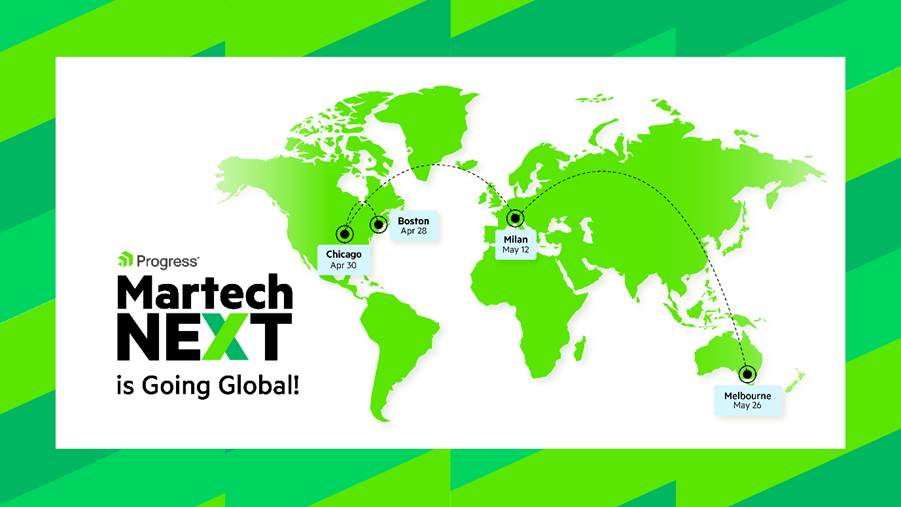
Progress MartechNEXT Is Going Global: The 2026 World Tour